La Gran Città del Cairo
La Gran Città del Cairo | Prints | BERTELLI Donato
La Gran Città del Cairo
La Gran Città del Cairo | Prints | BERTELLI Donato
Payment methods
- PayPal
- Credit card
- Bank transfer
- Pubblica amministrazione
- Carta del Docente
Details
- Year of publication
- 1569
- Size
- 285 X 200
- Engravers
- BERTELLI Donato
- Keyword
- Cartografia Rara
Description
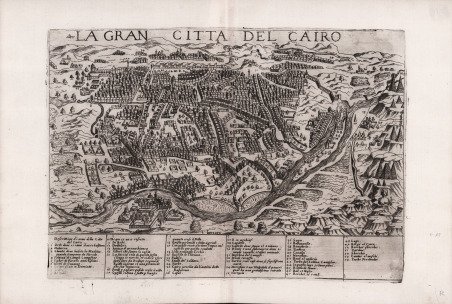
In alto, lungo il margine superiore ed impresso a caratteri cubitali, troviamo il titolo: LA GRAN CITTA DEL CAIRO. In basso si legge: Descrittione d’i nomi della Città del Cairo. Segue una legenda numerica di 54 rimandi a luoghi e monumenti notabili disposta su sei colonne. In basso a destra troviamo l’imprint editoriale: Appresso Donato Bertelli. Orientazione nei quattro lati al centro con i nomi dei venti: TRAMONTANA, LEVANTE, PONENTE, mentre non indicato il vento meridionale. Il nord è a sinistra. Pianta prospettica a volo d’uccello, priva di data, pubblicata dalla tipografia di Donato Bertelli. Si tratta di una derivazione dell’opera attribuita a Ferrando Bertelli (1568), a sua volta basata su quella più grande di Zorzi-Pagano, alla quale viene aggiunta l’orientazione. Nel 1549 Matteo Pagano, in collaborazione con il pittore e cartografo Giovanni Domenico Zorzi, produce un grande mappa del Cairo, composta da ventuno blocchi silografici. La prospettiva adottata, obliqua dall’alto, detta “a volo d’uccello”, segue la tradizione rinascimentale della rappresentazione delle città. Il formato è orizzontale, con la città vista dalla riva occidentale del Nilo. Sono indicati in maniera chiara sia aree individuali che monumenti della città, come il distretto di Azbakiya, la porta di Bab Zuwayla, l’acquedotto e le vie principali, il Vecchio Cairo, sviluppato intorno alla fortezza di Babilonia, la torre di Giza, le celebri Piramidi e la Sfinge in sembianze femminili. ' Alcuni esemplari di questa pianta prospettica si trovano inseriti nella raccolta ' Le vere imagini et descritioni delle piu nobili città del mondo, edita a Venezia da Donato Bertelli nel 1569. Altre ancora sono inseriti in raccolte fattizie cinquecentesche di formato più grande. “In assoluta concorrenza con le raccolte di Forlani e di Ferrando Bertelli, fu pubblicata a Venezia, sempre a cura di Donato Bertelli nel 1569, la raccolta ' Le vere imagini et descritioni delle piu nobilli città del mondo. Verae illustrissimae cuiusque urbis imagines nunc prim[um] typis impressae. Venetiis, Apud Donatum Bertellii ad signum divii Marci MDLXIX. Come quella di Ferrando, l’opera contiene un frontespizio allegorico inciso, con un titolo bilingue in italiano e latino, e con la dedica a Iohan Jacob Fugger von Kirhberg (1514-1575), banchiere tedesco mecenate delle arti: ' Illustri, ac generoso heroi d. Ioanni Iacobo Fuggero Kirchbergae, Weissenhorni, et c. domino caesareae maiestatis consiliario dicatae. La raccolta, che conobbe una ristampa nel 1574 e una nel 1578, comprende il titolo e 21 piante o vedute di città. Si tratta, dunque, solo di una selezione incentrata sulle città principali, rappresentate da tavole derivate dal “Primo Libro”, già replicate ' nel Civitatum aliquot insigniorum et locorum ' del 1568. Vengono escluse le immagini delle città fortificate ungheresi e dei luoghi minori, in una sorta di prodotto elitario, meno innovativo ma più curato dal punto di vista grafico. Valerio (cfr. ' Piante e vedute di Napoli dal 1486 al 1599, 1998, p. 45) descrive l’esemplare conservato alla Jerome & Ann Fisher Fine Arts Library della University of Pennsylvania [711.4 B486], datato 1569, e la ristampa del 1578 conservata alla Public Library di New York. Entrambi differiscono, per contenuto e ordinamento delle tavole, da quello conservato alla Biblioteca Angelica di Roma [BB-12-9] e da quello alla Stanford University, che recano entrambi la data 1578. L’unico elemento comune a tutte le edizioni è la presenza della pianta di Venezia (come prima tavola. Non è raro trovare le tavole di Bertelli conservate in raccolte fattizie di grande formato: in quella della Universiteto Biblioteka di Vilnius (cfr. Dzikowski, ' Katalog atlasów Biblioteki Uniwersyteckiej Stefana Batorego, 1940) sono presenti la quasi totalità delle tavole che compongono la raccolta, come pure nel cosiddetto “Atlante Aragona” (conservato in un’anonima coll. At the top, along the upper margin and printed in block letters, is the title LA GRAN CITTA DEL CAIRO. At the bottom we read: Descrittione d'i nomi della Città del Cairo. Follows a numerical legend of 54 references to places and monuments placed on six columns. At lower right is the editorial imprint: Appresso Donato Bertelli. Orientation in the four sides to the center with the names of the winds: TRAMONTANA, LEVANTE, PONENTE, while not indicated the southern wind. The north is on the left. Perspective bird's eye plan, undated, published by the typography of Donato Bertelli. This is a derivation of the work attributed to Ferrando Bertelli (1568), in turn based on the larger one by Zorzi-Pagano, to which the orientation is added. In 1549 Matteo Pagano, in collaboration with the painter and cartographer Giovanni Domenico Zorzi, produced a large map of Cairo, consisting of twenty-one silographic blocks. The perspective adopted, oblique from above, called "bird's eye", follows the Renaissance tradition of the representation of cities. The format is horizontal, with the city seen from the west bank of the Nile. Both individual areas and monuments of the city are clearly indicated, such as the Azbakiya district, the Bab Zuwayla gate, the aqueduct and main streets, Old Cairo, developed around the Babylon fortress, the Giza tower, the famous Pyramids, and the Sphinx in female likeness. ' Some examples of this perspective plant are included in the collection Le vere imagini et descritioni delle piu nobili città del mondo, published in Venice by Donato Bertelli in 1569. Still others are included in sixteenth-century factual collections of larger format. “In absolute competition with the collections of Forlani and Ferrando Bertelli, was published in Venice, again edited by Donato Bertelli in 1569, the collection Le vere imagini et descritioni delle più nobilli città del mondo. Verae illustrissimae cuiusque urbis imagines nunc prim[um] typis impressae. Venetiis, Apud Donatum Bertellii to signum divii Marci MDLXIX. Like Ferrando's, the work contains an engraved allegorical frontispiece, with a bilingual title in Italian and Latin, and a dedication to Iohan Jacob Fugger von Kirhberg (1514-1575), a German banker and patron of the arts: Illustri, ac generoso heroi d. Ioanni Iacobo Fuggero Kirchbergae, Weissenhorni, et c. domino caesareae maiestatis consiliario dicatae. The collection, which was reprinted in 1574 and again in 1578, includes the title and 21 plans or views of cities. It is, therefore, only a selection focused on the main cities, represented by tables derived from the "Primo Libro", already replicated in the Civitatum aliquot insigniorum et locorum of 1568. Images of Hungarian fortified cities and minor places are excluded, in a sort of elitist product, less innovative but more accurate from the graphic point of view. Valerio (cf. Piante e vedute di Napoli dal 1486 al 1599, 1998, p. 45) describes the copy preserved at the Jerome & Ann Fisher Fine Arts Library of the University of Pennsylvania [711.4 B486], dated 1569, and the reprint of 1578 preserved at the Public Library of New York. Both differ in content and arrangement of plates from the one preserved at the Angelica Library in Rome [BB-12-9] and the one at Stanford University, both of which bear the date 1578. The only common element in all editions is the presence of the plan of Venice (as the first plate. It is not uncommon to find Bertelli's plates preserved in large-format factual collections: in the collection of the Universiteto Biblioteka of Vilnius (cf. Dzikowski, Katalog atlasów Biblioteki Uniwersyteckiej Stefana Batorego, 1940) almost all the plates that make up the collection are present, as well as in the so-called "Atlas Aragon" (preserved in an anonymous private American collection and of which we have been able to obtain images). Numerous plates are present in the collection of the Bertarelli Collection [VOL EE 46 (1-240)], preserved. Cfr.