Details
Keyword
Scuola Inglese & Americana
Description
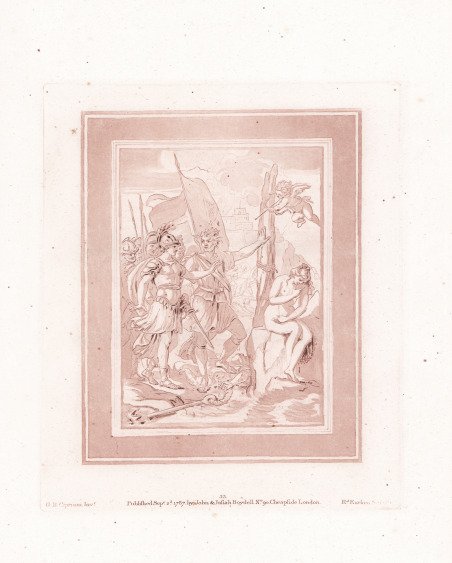
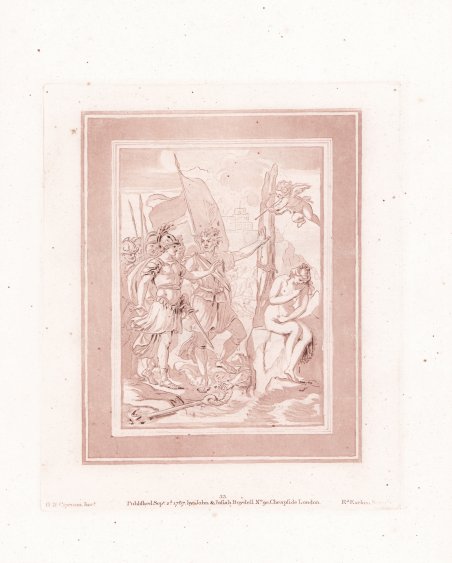
Acquatinta e acquaforte, stampata in seppia, 1789. Dalla serie: ' A collection of prints, after the sketches and drawings of the late celebrated Giovanni Battista Cipriani ' pubblicata a Londra da John & Josiah Boydell nel 1789. La serie consiste di cinquanta stampe da disegni di Cipriani 'incisi da Mr. Richard Earlom' inclusee sette incise da Maria Catharina Prestel, Bartolozzi, Kirk e Legat. Richard Earlom (1743-1822) fu uno dei più grandi incisori a mezzatinta e a puntini del suo tempo. Fu apprendista dell'incisore londinese G.B. Cipriani e studiò alla St Martin's Lane Academy. Vinse molti premi per i suoi disegni e incisioni. Nel 1774, iniziò a lavorare per John Boydell per il quale creò trecento tavole dopo Claude, pubblicate come il Liber Veritas (1777-1819). Creò anche per Boydell cinquantuno tavole di Cipriani. Earlom incise opere eccezionali sia dopo i disegni dei suoi contemporanei che dopo i vecchi maestri. Boydell commissionò il suo talento per alcune delle più famose tavole della Houghton Gallery e della Shakespeare Gallery. Giovanni Battista Cipriani, (1727-1785) fu un pittore decorativo e designer fiorentino, attivo principalmente in Inghilterra. Nel 1755 fu portato a Londra dall'architetto Sir William Chambers e dallo scultore Joseph Wilton, che lo avevano conosciuto a Roma. Fu impiegato nella decorazione di molti edifici pubblici e case private e in alcuni casi progettò dettagli architettonici come intonaco, legno e scultura in pietra. Buoni esempi dei suoi dipinti sono alla Somerset House (dove lavorò per Chambers) e nel Philadelphia Museum of Art (una serie originariamente eseguita per Lansdowne House, Londra). Fu anche attivo come insegnante alla Royal Academy (fu membro fondatore nel 1768 e disegnò il suo diploma), e i suoi numerosi disegni decorativi (molti incisi da Bartolozzi, suo amico dai tempi degli studenti) ebbero una grande influenza. Il lavoro di Cipriani è compiuto piuttosto che ispirato, ma fu, nelle parole di Sir Ellis Waterhouse, 'una delle grandi figure di retrovia dello stile neoclassico in Inghilterra'. Aquatint and etching, printed in sepia ink, 1789. ' From the series: ' A collection of prints, after the sketches and drawings of the late celebrated Giovanni Battista Cipriani ' published in London by John & Josiah Boydell in 1789. The series consists of fifty-plate series of facsimile prints of Cipriani's drawings 'engraved by Mr. Richard Earlom' includes seven engraved by Maria Catharina Prestel, Bartolozzi, Kirk and Legat. A letterpress contents page of the same sheet size, kept under Earlom's name with the majority of the series, gives titles and the series publication date of September 1st, 1789. Richard Earlom (1743-1822) was one of the greatest mezzotint and stipple engravers of his day. He was apprenticed to the London based engraver, G.B. Cipriani and studied at the St Martin's Lane Academy. He won many prizes for his drawings and engravings. In 1774, he began work for John Boydell for whom he created three hundred plates after Claude, published as the Liber Veritas (1777-1819). He also created for Boydell fifty-one plates after Cipriani. Earlom engraved outstanding works both after the designs of his contemporaries and after the old masters. Boydell commissioned his talents for some of the most famous plates in The Houghton Gallery and The Shakespeare Gallery. ' Giovanni Battista Cipriani, (1727-1785) was a Florentine decorative painter and designer, active mainly in England. In 1755 he was brought to London by the architect Sir William Chambers and the sculptor Joseph Wilton, who had met him in Rome. He was employed in the decoration of many public buildings and private houses and in some cases designed such architectural details as plasterwork, woodwork, and stonecarving. Good examples of his paintings are at Somerset House (where he worked for Chambers) and in the Philadelphia Museum of Art (a series originally executed for Lansdowne House, London). He was also active as a teacher at the Royal Academy (he was a foundation member in 1768 and designed its diploma), and his numerous decorative designs (many engraved by Bartolozzi, his friend since student days) had wide influence. Cipriani's work is accomplished rather than inspired, but he was, in the words of Sir Ellis Waterhouse, 'one of the great backroom figures of the Neoclassic style in England'. Cfr.

 Find out how to use
 Find out how to use