La Resurrezione
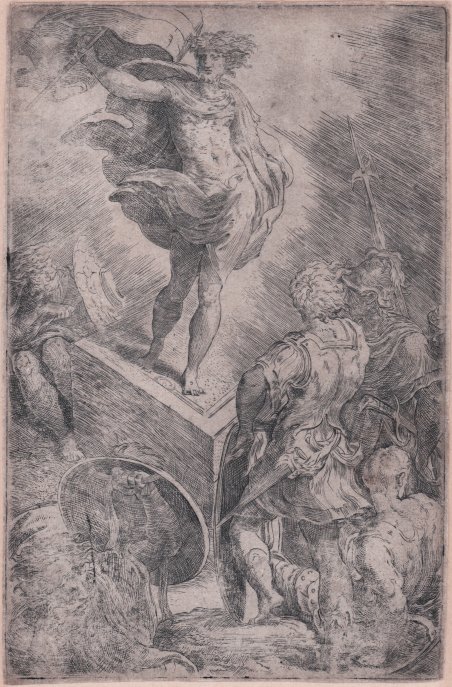
La Resurrezione
Payment methods
- PayPal
- Credit card
- Bank transfer
- Pubblica amministrazione
- Carta del Docente
Details
- Year of publication
- 1531
- Size
- 136 X 211
- Engravers
- PARMIGIANINO Francesco Maria Mazzola detto
Description
Acquaforte e puntasecca, databile al periodo 1531/40, priva della firma dell’artista. Bellissima prova, impressa su carta vergata coeva priva di filigrana, rifilata al rame o con sottilissimi margini, tracce di leggere abrasioni perfettamente restaurate, per il resto in ottimo stato di conservazione. L’interesse per la grafica da parte del grandissimo artista inizia durante il suo viaggio a Roma del 1524 dove frequenta Marcantonio Raimondi e la sua bottega, apprendendo la tecnica del maestro bolognese e l’uso dell’acido. A Roma conosce anche Ugo da Carpi da cui apprende la tecnica del chiaroscuro, ideale per la traduzione a stampa dei disegni. Proprio nella capitale il Parmigianino incide San Pietro e San Giovanni guariscono gli infermi (Bartsch 7), suo celebre primo lavoro grafico all’ acquaforte derivante da un disegno di Raffaello, che rimane l’unica opera prodotta prima del ritorno a Parma. Tutta la restante produzione grafica risale quindi al periodo successivo al 1531. La scelta dell’artista di dedicarsi personalmente ad una tecnica considerata minore e marginale nasce probabilmente dall’intuizione di poter riprodurre in più esemplari i suoi lavori che attraverso l’uso dell’acquaforte rimanevano molto vicini all’immediatezza del disegno, senza mostrare quella rigidità di traduzione propria dell’incisione al bulino. Il Mazzola si dedicò all’incisione in modo sporadico, per le difficoltà che incontrava nell’usare l’acido; per questo i suoi lavori presentano spesso difetti di morsura, che contraddistinguono gran parte dell’opera grafica di questo maestro sperimentatore, rendendo spesso controversa la catalogazione degli stati delle incisioni. Secondo il recente catalogo di Mistrali sono quattro gli stati de La Resurrezione; il nostro esemplare presenta caratteristiche comuni a più stati descritti, confermando proprio la consueta differenza di impressioni tipica delle opere del Parmigianino, di difficilissima catalogazione. In precedenza, la Resurrezione venne eliminata dal corpus delle opere del Parmigianino, mentre attualmente nessuno mette più in dubbio il fatto che il foglio sia una delle più affascinanti acqueforti dell’artista. L’opera è caratterizzata dalla vivacità data dall’armonioso movimento delle figure e dal gioco degli effetti luminosi, che risaltano la figura del Cristo. Questo effetto di chiaroscuro viene ottenuto dal Mazzola attraverso delle aggiunte con la puntasecca, visibili soprattutto nello sfondo. L’analisi stilistica sui disegni preparatori all’opera inducono gli studiosi a datarla alla fine del periodo romano, verso il 1527. Bibliografia Bartsch, XVI, 6, Mistrali 16; Parmigianino e il manierismo europeo pp. 330/331, 2.4.4; Parmigianino und sein Kreis, druckgraphik aus der Sammlung Baselitz, pp. 81/85, 24. Etching and drypoint, between 1531 and 1540, not signed by the artist. Excellent work, printed on contemporary laid paper without watermark, trimmed to platemark or with small margins, signs of light abrasions perfectly repaired, otherwise in excellent condition. Parmigianino owes his interest in graphic arts to his trip to Rome in 1524, when he met Marcantonio Raimondi “In this intimated composition, Christ is restore to life in a burst of light before a group of six soldiers, several of whom shield themselves from the brilliant apparition. For devising the composition, Parmigianino relied on Albrecht Dürer’s engraving of the Resurrection from the Small Passion series (1512): the stance of Christ, with one leg before the other, an abundant swirl of drapery that envelops him, the slab with ring handles sealing the stone tomb, and the crouching figure at the lower left are all elements inspired by Dürer's earlier print. Parmigianino enhanced the drama by depicting Christ in a flash of bright light. Other compositional devices animate the scene, including tilting the angle of the tomb toward the picture plane and abruptly cutting off the figure in the lower left corner. The graceful contrapposto of Christ's pose and the sweeping curved lines of the soldier standing with his back to us in the foreground give a characteristic elegance and balance to the scene. An ink and wash drawing of the Resurrection by Parmigianino in the Morgan Library & Museum may be an early study for the composition, in spite of there being many differences between it and the etched image. In the sketch, Christ leaps off the lid of the tomb before several reclining figures, including a man viewed from behind who adopts a pose similar to that of the soldier seated at lower right in the etching. A red chalk drawing at Windsor shows three sketches of a warrior shielding himself in poses evocative of the figure in the lower left corner of the etching. The Resurrection can be compared to Parmigianino's Lovers ' in the intricacy of the hatching and the different systems of lines that were deployed to create rich tonal effects. The print exists in at least seven states, though only the earliest changes to the plate represent Parmigianino's own interventions. In the first state, known in a single impression in the Uffizi, the composition was executed entirely in etching apart from the fine drypoint rays emanating from Christ. In the second state […] delicate drypoint lines further define the back of the standing foreground soldier, the tip of ' halberd, the helmet, shoulder, and arm of the figure to his right, the face of Christ, the lid of the tomb, and various other areas. In the third state, the end of the halberd is extended upward, the sleeve of the crouching left-hand figure now has a small split, and shading is added to the right thigh of the standing soldier and to Christ's flag. The changes between the third and fourth states constitute the simple extension of a few rays between the halberd and Christ, one of which touches the edge of his drapery. Typical of Parmigianino's working procedure, this additional drypoint serves to heighten contrast or strengthen contours rather than introduce major alterations to the design. ' The plate went through at least three further state changes, which were mostly undertaken with the burin to reinforce weakening lines. In the latest impressions, which may date to the seventeenth century, the plate was entirely reengraved, leaving little sign of Parmigianino’s original draftsmanship. This transformation is highlighted by the apparence of Christ, whose bold features and rather disdainful expression little resemblance to Parmigianino’s elegant figure” C. Jenkins, ' The Renaissance of Etching, p. 145. N. 64 Bibliografia Bartsch, XVI, 6, Mistrali 16; ' Parmigianino e il manierismo europeo ' pp. 330/331, 2.4.4; ' Parmigianino und sein Kreis, druckgraphik aus der Sammlung Baselitz, pp. 81/85, 24. Cfr.
