La «Roma “Cesi”» tra due barbari o Roma trionfante
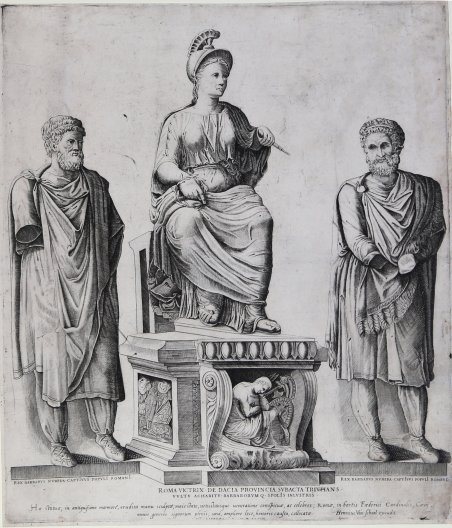
La «Roma “Cesi”» tra due barbari o Roma trionfante
Payment methods
- PayPal
- Credit card
- Bank transfer
- Pubblica amministrazione
- Carta del Docente
Details
- Year of publication
- 1549
- Size
- 380 X 445
- Engravers
- BEATRICETTO Nicolas Beatrizet detto
- Inscription description
- Huelsen p. 158, 72 b/d; Bartsch p.264, 89; Bianchi 2003c, p. 3, n. 97; Rubach n. 338, IV/V; Alberti n. 85, IV/V; Marigliani V.54.
Description
Bulino, 1549, datato in lastra in basso al centro. Esemplare nel quarto stato di cinque descritto da Alessia Alberti, con l’indirizzo dell’editore Henrich van Schoel. Bellissima prova, impressa su carta vergata coeva priva di filigrana, con sottili margini, in ottimo stato di conservazione. Iscritto in basso al centro: «ROMA VICTRIX DE DACIA PROVINCIA SVBACTA TRIVMPHANS VVLTV AC HABITV BARBARORVM Q[VE] SPOLIS INLVSTRIS» [Roma vincitrice che trionfa sulla Dacia assoggettata - notevole per il volto, l’abito e il bottino dei barbari]. Iscritto in basso a sinistra: «REX BARBARVS NVMIDA CAPTIVVS POPOVLI ROMANI» [Re Numida, prigioniero del popolo romano]. Iscritto in basso a destra: «REX BARBARVS NVMIDA CAPTIVVS POPOVLI ROMANI» [Re Numida, prigioniero del popolo romano]. Iscritto in basso: «Hæ statuæ in antiquissimo marmore, erudita manu sculptæ, maiestate, uetustatisque ueneratione conspicuæ, ac celebres; Romae, in hortis Fæderici Cardinalis Cæsij omnis generis signorum plenis, una, ampliore loco, honoris causa, collocatæ · Ant Lafreri R[omae] ? D XLVIIII» [Queste statue, in marmo antichissimo, scolpite da una mano esperta, notevoli e celebri per maestà, antichità e venerazione, a Roma, collocate tutte insieme per l’onore che meritano in un luogo più ampio, negli orti del cardinale Federico Cesi, piene di tutti i loro segni]. “Le tre statue facevano parte della collezione del cardinale Paolo Emilio Cesi (1481- 1537), appassionato raccoglitore di epigrafi e di statue antiche. Nell’incisione del Beatrizet è riprodotta al centro la statua della Dea Roma seduta in trono, e nella base il rilievo con la Germania capta. Il gruppo può datarsi al II secolo d.C. Ai lati, due statue di re barbari dello stesso periodo, provengono con molta probabilità dal Foro di Traiano. Un primo disegno delle due statue laterali, senza testa e mutilate, era stato prodotto dall’Heemskerck che lo raffigurò, lungo il muro in un angolo del giardino di casa Cesi. L’Aldovrandi nella sua opera Delle statue antiche […] edita nel 1550 così la definiva: «gran statua marmorea intiera vestita et assisa su una sedia di marmo, con una corona di lauro nella man destra e con uno stocco nella sinistra, et ha in testa un elmetto. Vogliono che ella sia una Roma trionfante. È collocata questa bella statua sopra una base antica dinanzi a la quale base è di mezzo rilievo la Dacia tutta mesta vestita» (Aldovrandi). Le statue, benché mutile, suscitarono notevole interesse tanto da indurre Clemente XI (1700-1721) ad acquistarle, come risulta dal chirografo del 4 marzo 1719, per collocarle in Campidoglio” (cfr. Marigliani, ' Lo splendore di Roma nell’Arte incisoria del Cinquecento). L’opera appartiene allo ' Speculum Romanae Magnificentiae, la prima iconografia della Roma antica. La lastra figura nell'Indice del Lafreri al n. 250, descritta come ' Roma trionfante con il re Numida prigione in casa del Cardinale Cesis. Lo ' Speculum ' ebbe origine nelle attività editoriali di Antonio Salamanca e Antonio Lafreri (Lafrery). Durante la loro carriera editoriale romana, i due editori - che hanno lavorato insieme tra il 1553 e il 1563 - hanno avviato la produzione di stampe di architettura, statuaria e vedutistica della città legate alla Roma antica e moderna. Le stampe potevano essere acquistate individualmente da turisti e collezionisti, ma venivano anche acquistate in gruppi più grandi che erano spesso legati insieme in un album. Nel 1573, Lafreri commissionò a questo scopo un frontespizio, dove compare per la prima volta il titolo Speculum Romanae Magnificentiae. Alla morte di Lafreri, due terzi delle lastre di rame esistenti andarono alla famiglia Duchetti (Claudio e Stefano), mentre un altro terzo fu distribuito tra diversi editori. Claudio Duchetti continuò l’attività editoriale, implementando le lastre dello Speculum con copie di quelle “perdute” nella divisione ereditaria, che fece incidere al milanese Amborgio Bram. Engraving, 1549, dated on lower centre plate. Example in the fourth state of five, with the address of the publisher Henrich van Schoel. Beautiful work, printed on contemporary laid paper without watermark, with thin margins, in excellent condition. The three statues were part of the collection of Cardinal Paolo Emilio Cesi (1481-1537), a passionate collector of epigraphs and ancient statues. In the Beatrizet's engraving, the statue of the goddess Roma seated on a throne is reproduced in the center, and in the base the relief with Germany captures. The group can date back to the 2nd century AD. On the sides, two statues of barbarian kings of the same period, most likely come from the Trajan's Forum. The work belongs to the Speculum Romanae Magnificentiae, the earliest iconography of ancient Rome. ' The Speculum originated in the publishing activities of Antonio Salamanca and Antonio Lafreri (Lafrery). During their Roman publishing careers, the two editors-who worked together between 1553 and 1563-started the production of prints of architecture, statuary, and city views related to ancient and modern Rome. The prints could be purchased individually by tourists and collectors, but they were also purchased in larger groups that were often bound together in an album. In 1573, Lafreri commissioned a frontispiece for this purpose, where the title Speculum Romanae Magnificentiae appears for the first time. Upon Lafreri's death, two-thirds of the existing copperplates went to the Duchetti family (Claudio and Stefano), while another third was distributed among several publishers. Claudio Duchetti continued the publishing activity, implementing the Speculum plates with copies of those "lost" in the hereditary division, which he had engraved by the Milanese Amborgio Brambilla. Upon Claudio's death (1585) the plates were sold - after a brief period of publication by the heirs, particularly in the figure of Giacomo Gherardi - to Giovanni Orlandi, who in 1614 sold his printing house to the Flemish publisher Hendrick van Schoel. Stefano Duchetti, on the other hand, sold his own plates to the publisher Paolo Graziani, who partnered with Pietro de Nobili; the stock flowed into the De Rossi typography passing through the hands of publishers such as Marcello Clodio, Claudio Arbotti and Giovan Battista de Cavalleris. The remaining third of plates in the Lafreri division was divided and split among different publishers, some of them French: curious to see how some plates were reprinted in Paris by Francois Jollain in the mid-17th century. Different way had some plates printed by Antonio Salamanca in his early period; through his son Francesco, they goes to Nicolas van Aelst's. Other editors who contributed to the Speculum were the brothers Michele and Francesco Tramezzino (authors of numerous plates that flowed in part to the Lafreri printing house), Tommaso Barlacchi, and Mario Cartaro, who was the executor of Lafreri's will, and printed some derivative plates. All the best engravers of the time - such as Nicola Beatrizet (Beatricetto), Enea Vico, Etienne Duperac, Ambrogio Brambilla, and others ' - were called to Rome and employed for the intaglio of the works. All these publishers-engravers and merchants-the proliferation of intaglio workshops and artisans helped to create the myth of the Speculum Romanae Magnificentiae, the oldest and most important iconography of Rome. The first scholar to attempt to systematically analyze the print production of 16th-century Roman printers was Christian Hülsen, with his Das Speculum Romanae Magnificentiae des Antonio Lafreri of 1921. In more recent times, very important have been the studies of Peter Parshall (2006) Alessia Alberti (2010), Birte Rubach and Clemente Marigliani (2016). Cfr. Huelsen p. 158, 72 b/d; Bartsch p.264, 89; Bianchi 2003c, p. 3, n. 97; Rubach n. 338, IV/V; Alberti n. 85, IV/V; Marigliani V.54.
