La Vergine, il Bambino e San Giovannino
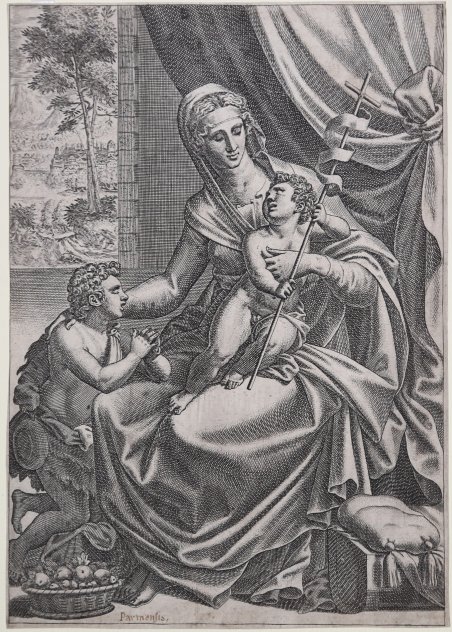
La Vergine, il Bambino e San Giovannino
Payment methods
- PayPal
- Credit card
- Bank transfer
- Pubblica amministrazione
- Carta del Docente
Details
- Year of publication
- 1550
- Size
- 243 X 191
- Engravers
- BOYVIN Renè
- Inscription description
- Robert-Dumesnil, Le Peintre-Graveur Français, VIII.20.8.
Description
Acquaforte e bulino, circa 1540/50, privo di data ed elementi editoriali. Da un soggetto di Luca Penni o Rosso Fiorentino. Magnifica prova, impressa su carta vergata coeva, rifilata al rame, in ottimo stato di conservazione. L’opera, molto rara, è attribuita al Boyvin da Robert-Dumesnil che non chiarisce se derivi da un disegno del Penni o del Rosso. Renè Boyvin è incisore, acquafortista e disegnatore francese. Vasari, nella sua Vita di Marcantonio Raimondi, dice che “dopo la morte di Rosso [Fiorentino], assistiamo all’arrivo dalla Francia di tutte incisioni dei suoi lavori”. Vasari attribuì questa abbondanza di riproduzioni “all’incisore in rame René”, ovvero René Boyvin. Questi si trasferì a Parigi nel 1545 circa da Agers, dove incontrò Antonio Fantuzzi e dove si dice abbia rinnovato il contratto di servizio con l’incisore Pierre Milan nel 1549. Successivamente, aprì il suo studio presso il quale lavorò anche Lorenzo Penni, figlio di Luca. Boyvin visse a lungo, malgrado la prigionia a cui venne costretto a causa del suo credo Calvinista. Virgin sitting in an interior with child Christ holding a cross on her knees, and St John the Baptist kneeling next to her, his hands joined in prayer. Etching and engraving, circa 1540/50, without any details. After Luca Penni or Rosso Fiorentino. A great impression, printed on contemporary laid paper, trimmed to the platemark, in very good conditions.The work, very rare, is attributed to Boyvin by Robert-Dumesnil who does not clarify if it derives from a drawing of Penni or Rosso Fiorentino. Renè Boyvin is a French engraver, etcher and draftsma. Vasari, in his Life of Marcantonio Raimondi, says that “dopo la morte di Rosso [Fiorentino], assistiamo all’arrivo dalla Francia di tutte incisioni dei suoi lavori”. Vasari attributed this abundance of reproductions “all’incisore in rame René”, or René Boyvin.They moved to Paris in 1545 to about Agers, where he met Antonio Fantuzzi and where it is said to have renewed his contract of service with the engraver Pierre Milan in 1549. Later, he opened his own office where he also worked Lorenzo Penni, son of Luca. Boyvin lived a long time, in spite of the imprisonment to which he was forced to because of its Calvinistic creed. Cfr. Robert-Dumesnil, Le Peintre-Graveur Français, VIII.20.8.
