Mere, Danseur et Musicien
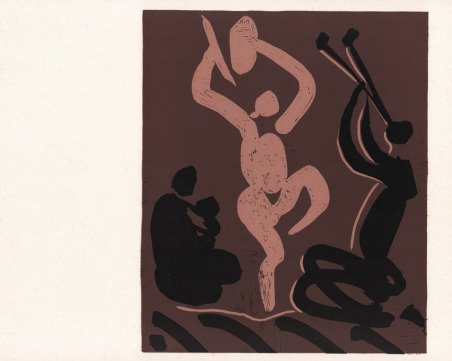
Mere, Danseur et Musicien
Payment methods
- PayPal
- Credit card
- Bank transfer
- Pubblica amministrazione
- Carta del Docente
Details
- Year of publication
- 1962
- Size
- 320 X 375
- Engravers
- PICASSO Pablo
Description
Questa composizione ricca di colori si anima di movimento e musica attraverso i nostri tre soggetti: una madre, una ballerina e un musicista. ' I colori sono equilibrati, i toni doppi del cioccolato-marrone si completano bene, con i caratteri neri sui lati usati per definire la composizione. ' La Madre è collocata sulla sinistra, mentre avvolge il suo bambino, mentre la Ballerina è al centro e costituisce la figura principale di questo lavoro. ' Dotata di un paio di piatti, la figura è sospesa in movimento, una posa da piroetta che mette in risalto il Musicista sulla destra che porta uno strumento a due corna che crea la musica che guida la scena. Originariamente rilegata nella prima edizione del ' Picasso Linogravures, ' (con la firma e il numero a matita di Pablo Picasso), questa straordinaria linoleografia fu pubblicata in un'edizione limitata di 50 copie (Casa editrice Gerd Hatje, Stoccarda 1962). Nella introduzione del libro Picasso Linogravures, pubblicato Gerd Hatje, ' Stuttgart ' and ' Éditions Cercle d’Art, Paris in 1962, ' Wilhem Boeck spiega il perchè Picasso ha iniziato a realizzare libri con questo tipo di tecnica di stampa: “Picasso ' had recently become an adept of cut-linoleum printing. It was a new activity, and doubtless owed to the artist’s desire to give colour pride of place within printed creations when graphic arts had, until then, consigned it to a subordinate role – even in lithography. Taking up the gouge was less, for Picasso, about exploring a new realm of objects and forms, then exposing the forms he had mastered to the rigours of as-yet untested technical possibilities. As he did every time he embarked on a new task, be it sculpture, lithography, ceramics or aquatints, the result obtained can be compared to nothing but previous creations by Picasso himself”. Picasso ha inventato il metodo della riduzione, tagliando progressivamente lo stesso blocco di linoleum per ogni nuovo colore. Nel 1962, in collaborazione con Picasso e la Galerie Louise Leiris, sono state realizzate nuove lastre di linoleum al 42% della dimensione originale, ed è da queste che sono state realizzate le stampe [Dimensioni: 12,6 x 14,2 in (32 x 36 cm)], per l’edizione Circle d'Art, Parigi 1962. Queste linoleografie sono rinomate per la loro alta qualità e fedeltà a Picasso. Una bella impressione con colori freschi e margini pieni. ' Bibliografia Bloch, G. (1984). Pablo Picasso, Tome I Catalogue de l’œuvre grave et lithographié 1904 – 1967, no. 929 on pg. 202. This richly-colored, whimsical composition comes alive with movement and music through our three subjects: a Mother, a Dancer, and of course, a Musician. ' The colors are evenly balanced, the dual tones of the chocolate-brown complement each other well, with the black characters on the sides used to anchor the overall piece. ' Our Mother is seen on the left, swaddling her baby in a seated position while our Dancer is seen at the center and the main attraction of this work. ' Equipped with a pair of cymbals, the figure is suspended in motion, a pirouette-like pose which accents our Musician on the right who carries a dual-horned instrument creating the music that drives 2our scene. Originally bound into the first edition of picasso linogravures (with the signature and number in pencil by Pablo Picasso), this extraordinary linocut was published in a limited edition of 50 copies (Publishing house Gerd Hatje, Stuttgart 1962). In the introduction of the book, published by ' Verlag Gerd Hatje, ' Stuttgart ' and ' Éditions Cercle d’Art, Paris in 1962, ' Wilhem Boeck ' tells us why the great artist started to make a book with this printing technique: “Picasso ' had recently become an adept of cut-linoleum printing. It was a new activity, and doubtless owed to the artist’s desire to give colour pride of place within printed creations when graphic arts had, until then, consigned it to a subordinate role – even in lithography. Taking up the gouge was less, for Picasso, about exploring a new realm of objects and forms, then exposing the forms he had mastered to the rigours of as-yet untested technical possibilities. As he did every time he embarked on a new task, be it sculpture, lithography, ceramics or aquatints, the result obtained can be compared to nothing but previous creations by Picasso himself”. Picasso invented the ereduction method, progressively cutting the same linoblock for each new colour, ' making it impossible to take any further prints from the original plates. In 1962, in collaboration with Picasso and Galerie Louise Leiris, new linoleum plates were made at 42% of the original size, and it was from these that the prints were made [Size: 12.6 x 14.2 in (32 x 36 cm)]. For France edition Circle d'Art, Paris 1962. These linocuts are renowned for their high quality and fidelity to Picasso's. A fine impression with fresh colors and full margins. Bibliografia Bloch, G. (1984). Pablo Picasso, Tome I Catalogue de l’œuvre grave et lithographié 1904 – 1967, no. 929 on pg. 202. Cfr.
