Minerva presenta la Pittura alle Arti Liberali (Allegoria della Pittura)
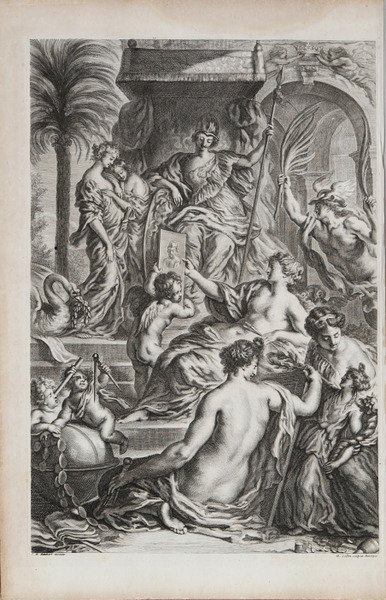
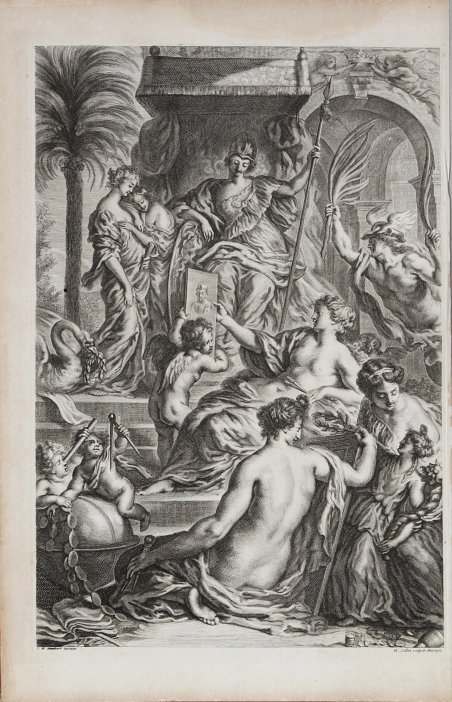
Minerva presenta la Pittura alle Arti Liberali (Allegoria della Pittura)
Payment methods
- PayPal
- Credit card
- Bank transfer
- Pubblica amministrazione
- Carta del Docente
Details
- Year of publication
- 1676
- Size
- 228 X 335
- Engravers
- COLLIN Richard
Description
Minerva siede sul suo trono nell'Olimpo. Alla sua sinistra c'è la Poesia con un cigno, alla sua destra Mercurio viene camminando verso Minerva con rami di palma. Sui gradini del trono di Minerva, la Pittura, Scultura e l’Architettura che stanno lavorando. Acquaforte e bulino, 1676, da Joachim von Sandrart. Firmata nel margine inferiore: "I. de Sandrart inventor." and "R. Collin sculpit Antverpia". Frontespizio per Joachim von Sandrart, L'Academia Todesca della Architectura Scultura e Pittura oder Teutsche Academie der Edlen Bau. Richard Collin (1626, Lussemburgo - 1698, Bruxelles), è stato un incisore. Allievo di Joachim von Sandrart a Roma, divenne maestro nella Corporazione di San Luca ad Anversa nel 1650-1651. Lavorò a Roma e ad Anversa, ed è noto per i ritratti che incise per il libro di artisti di Cornelis de Bie chiamato Het Gulden Cabinet. Negli anni 1660 prese degli allievi e nel 1678 si trasferì a Bruxelles e divenne l'incisore di corte di Carlo II di Spagna. ' Opera tratta dalla celebre ' Academia Todesca della Architectura, Scultura & Pittura: oder Teutsche Academie der Edlen Bau, Bild-und Mahlerey-Künste, raccolta monumentale, riccamente illustrata da centinaia di incisioni raffiguranti antichità, architettura e mitologia classica, edita a Norimberga e Francoforte tra il 1675 ed il 1680. ' L'opera è piena di illustrazioni di edifici romani antichi e moderni, scultura, teoria della pittura, biografie di artisti, tra cui artisti tedeschi e contemporanei (cioè del XVII secolo), e antichità. L'opera è dedicata alla nazione tedesca di fama mondiale e ai campioni e amanti dell'arte ('Der Welt-berühmten Teutschen Nation . Kunst-Helden und Kunstliebenden'). Bibliografia National Gallery (Washington), ' Mark J. Millard, III (1998), no. 111; F.W. H. Hollstein, ' German engravings . ca. 1400-1700 ' (1954-), 38-41; Anna Schreurs, ' Unter Minerva schutz: bildung durch kunst in Joachim von Sandrarts 'Teutscher Academie' ' (2012). Minerva sits on her throne in the Olymp. To her left is Poetry with a swan, to her right Mercury comes walking toward Minerva with palm branches. On the steps of Minerva's throne, Painting, Sculpture and Architecture are working. ' Etching with engraving 1676, after Joachim von Sandrart. Signed in lower margin: "I. de Sandrart inventor." and "R. Collin sculpit Antverpia". Title page for: Joachim von Sandrart, L'Academia Todesca della Architectura Scultura e Pittura oder Teutsche Academie der Edlen Bau. Richard Collin (1626, Luxembourg – 1698, Brussels), was an engraver; a pupil of Joachim von Sandrart in Rome, and became a master in the Antwerp Guild of St. Luke in 1650–1651. He worked in Rome and in Antwerp, and is known for portraits he engraved for Cornelis de Bie's book of artists called Het Gulden Cabinet. In the 1660s he took on pupils, and in 1678 he moved to Brussels and became the court engraver for Charles II of Spain. Plate taken fom the monumental ' Academia Todesca della Architectura, Scultura & Pittura: oder Teutsche Academie der Edlen Bau, Bild-und Mahlerey-Künste ' (Deutsche Academy of Architecture - Sculpture – Painting). ' The first edition, in German, was published by Joachim von Sandrart in Nuremberg, in three volumes respectively in 1675, 1679 and 1680. For the plates Sandrart used his students as and many others artist as ' Karl Gustav von Amling (1650-1703); Philip Kilian (1628-1693); Richard Collin (1627-97); Georg Andreas Wolfgang (1631-1716); Johann Georg Waldreich (d.1680); Melchior Küsel (1626-1683); Franck, Johann (fl.1659-1690); George Christoph Eimmart (1638-1705); Susanna Maria von Sandrart (1658-1716); Bartholomäus Kilian (1630-1696). The work is full of illustrations of ancient and modern Roman buildings, sculpture, the theory of painting, biographies of artists, including German and contemporary (ie seventeenth-century) artists, and antiquities. The work is dedicated to the world-renowned German nation and to champions and lovers of art ('Der Welt-berühmten Teutschen Nation . Kunst-Helden und Kunstliebenden'). References National Gallery (Washington), ' Mark J. Millard, III (1998), no. 111; F.W. H. Hollstein, ' German engravings . ca. 1400-1700 ' (1954-), 38-41; Anna Schreurs, ' Unter Minerva schutz: bildung durch kunst in Joachim von Sandrarts 'Teutscher Academie' ' (2012). Cfr.
