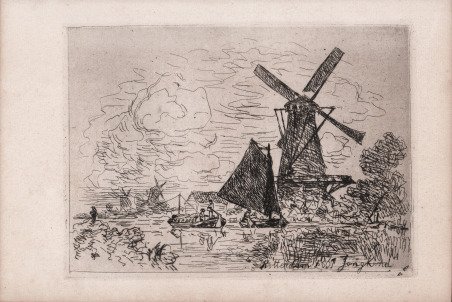
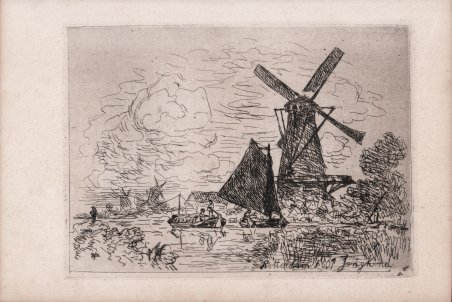
Uomini in due barche che navigano vicino al mulino a vento a destra; uomo in piedi a sinistra, mulini a vento e cottage visti in lontananza. Acquaforte, 1861, firmata e datata sulla lastra: "Rotterdam 1861 Jongkind". ' Esemplare del secondo stato di tre, prima dell'imprint di Cadart. ' Una bella impressione, stampata su carta vergata, con margini, condizioni perfette. Johan Barthold Jongkind nacque a Lattrop, un villaggio olandese nel comune di Dinkelland, vicino al confine con la Germania. La sua arte fu influenzata della tradizione paesaggistica fiamminga, in particolare l'opera di Rembrandt è stata una presenza costante in tutte le sue opere. Compì lunghi viaggi in Francia; la natura selvaggia della Normandia lo affascinò a tal punto che vi ritornò altre volte, fino al 1865. Fu in questi anni che frequentò Claude Monet, Edouard Manet ed Eugène Boudin - con i quali ebbe lunghe discussioni d'arte che influenzeranno le loro successive esperienze artistiche - e Charles Baudelaire, che ammirò la poesia delle sue vedute. I dipinti di questo periodo sono caratterizzati da freschezza e da vivacità: Johan Barthold Jongkind, attento osservatore della natura, usa pennellate vigorose e precise, per rendere con straordinaria abilità la luminosità delle onde del mare e delle nuvole nel cielo. ' Jongkind trascorse la maggior parte della sua vita in Francia, tornando regolarmente nei Paesi Bassi per trarre ispirazione, soprattutto a Rotterdam, per le sue vedute della città e del porto, nonché per i suoi paesaggi di navi costiere e fluviali. I suoi paesaggi al chiaro di luna erano straordinari. La sua pennellata spontanea e libera dava ai suoi dipinti l'immediatezza del lavoro degli impressionisti, eppure erano tutti dipinti nel suo studio. I suoi contemporanei francesi ammiravano il suo lavoro e generalmente lo consideravano uno dei pionieri dell'impressionismo: Manet lo descrisse come il padre dei moderni paesaggisti. Bibliografia L. Delteil, Le Peintre-Graveur Illustré (XIXe et XXe siècles), n. 14.II/III; Inventaire du Fonds Français: Bibliothèque Nationale, Département des Estampes, n. 13. Men in two boats sailing by windmill at right; man standing at left, windmills and cottages seen in distance; second state. ' Etching with surface tone, 1861, signed and dated on plate: "Rotterdam 1861 Jongkind". ' Example of the second state of three, before the Cadart’s imprint. A fine impression, printed on laid paper, with margins, perfect condition. ' Johan Barthold Jongkind was born in Lattrop, a Dutch village in the municipality of Dinkelland, near the German border. His art was influenced by the Flemish landscape tradition, in particular the work of Rembrandt was a constant presence in all his works. He made long trips to France; the wild nature of Normandy fascinated him so much that he returned there several times, until 1865. It was in these years that he met Claude Monet, Edouard Manet and Eugène Boudin - with whom he had long discussions about art that influenced their subsequent artistic experiences - and Charles Baudelaire, who admired the poetry of his views. The paintings of this period are characterized by freshness and liveliness: Johan Barthold Jongkind, careful observer of nature, uses vigorous and precise brushstrokes, to render with extraordinary skill the luminosity of the waves of the sea and the clouds in the sky. Jongkind spent most of his life in France, returning regularly to the Netherlands for inspiration, especially in Rotterdam, for his views of the city and harbor, as well as his landscapes of coastal and river ships. His moonlit landscapes were extraordinary. His spontaneous, free brushwork gave his paintings the immediacy of the Impressionists' work, yet they were all painted in his studio. His French contemporaries admired his work and generally considered him one of the pioneers of Impressionism; Manet described him as the father of modern landscape painters. Bibliografia L. Delteil, Le Peintre-Graveur Illustré (XIXe et XXe siècles), n. 14.II/III; Inventaire du Fonds Français: Bibliothèque Nationale, Département des Estampes, n. 13. Cfr.
 Find out how to use
 Find out how to use