Opus Praxitelis Opus Fiidiae
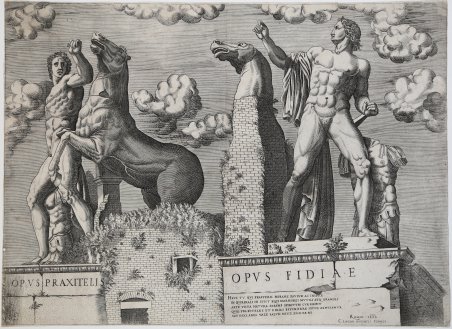
Opus Praxitelis Opus Fiidiae
Payment methods
- PayPal
- Credit card
- Bank transfer
- Pubblica amministrazione
- Carta del Docente
Details
- Year of publication
- 1584
- Size
- 495 X 362
- Engravers
- DUCHET (Duchetti) Claudio
Description
RARA VARIANTE stampata da Claudio Duchetti nel 1584, probabilmente incisa da Ambrogio Brambilla, copiando la lastra stampata da Antonio Lafreri nel 1546.Bulino, 1584, sul piedistallo, a sinistra: 'OPUS PRAXITELIS; a destra: OPUS FIDIAE, subito sotto: 'HEVS TU QVI PRAETERIS MORARE PAVLVM AC INSPICE/IN QVIRINALI HI SVNT EQVI MARMOREI MVTILI ATQVE GRANDES ARTE VICTA NATVRA PARENS SPIRITVM CVR EPIRIT QVID PRAXITELES ET FIDIAS EFFINXERE ISTOS AEMVLAMVR SAT DIXI ABEL VALE SALVE MISCE BIBE DA MI; in basso a destra i dati editoriali 'ROMAE 1584/CLAUDII DUCHETI FORMIS'. Magnifico esemplare, impresso su carta vergata coeva, rare e lievissime fioriture, un piccolo foro sulla sinistra, verso il basso, nel complesso in ottimo stato di conservazione.Erroneamente considerata quale variante della lastra pubblicato nel 1546 da Antonio Lafreri, come parte dello Speculum Romanae Magnificentiae, a sua volta copia in controparte di un foglio anonimo edito, senza data, da Antonio Salamanca, questa versione con l’indirizzo del Duchetti è invece una copia, molto simile al modello, da cui differisce in diversi particolari.Con la divisione ereditaria della tipografia Lafreri del 1581, la lastra originaria spettò al cugino di Claudio, Stefano Duchetti (cfr. V. Pagani. The dispersal of Lafreri’s inheritance, 1581-89, table a. Inventory of the Stefano Duchet – Paolo Graziani sale, 8 agosto 1581 p. 15 n. 23 “Il Cavallo de Campidoglio”, in Print Quarterly, vol. 25, n. 1, 200), di qui probabilmente l’esigenza per Claudio di farne incidere una nuova versione, forse affidandone l’incisione ad Antonio Brambilla, della cui collaborazione si era avvalso più volte. L’edizione del Duchetti risulta estremamente rara.La prima versione dell'opera fu pubblicata nel 1546 da Antonio Lafreri, a sua volta copia in controparte di un foglio edito, senza data, da Antonio Salamanca.Le statue sono copie romane del II-III secolo di originali greci del V sec. a.C. credute per tanto tempo copie di opere di artisti famosi tanto che sulle base è riportata la scritta “Opus Fidiae” e “Opus Praxitelis” e rappresentano i Dioscuri, i mitologici cavalieri figli di Giove che salvarono l’esercito romano al Lago Regillo.Sin dal Medioevo tutti i visitatori di Roma hanno potuto ammirarle nello stesso luogo dove sono ancora oggi e proprio per la loro presenza il Quirinale venne chiamato Montecavallo.La posizione in cui si trovano oggi è quella progettata da Flaminio Vacca per Sisto V, integrata dalle modifiche apportate nel 1783 da Carlo Antinori per Pio VI. Papa Sisto V voleva creare una mostra adeguata per il castello terminale dell’Acqua Virgo e pensò di utilizzare le due statue gigantesche che già si trovavano sulla piazza ed erano poste di fronte al Palazzo Vercelli o della Consulta; volle far girare le statue in modo che chiudessero visivamente lo scenario della Strada Pia – odierna Via XX Settembre – ed affidò l’incarico a Domenico Fontana che arretrò le statue e le mise in posizione frontale al Palazzo del Quirinale e vi pose una fontana davanti. L’ultimo spostamento delle statue fu voluto da Papa Pio VI che fece innalzare tra i due gruppi marmorei l’obelisco che si trovava nel Mausoleo di Augusto; i due gruppi furono divaricati per lasciar posto all’obelisco e davanti fu posta una vasca di granito che proveniva dal Campo Vaccino a raccogliere l’acqua che ricadeva dallo zampillo dell’Acqua Virgo. L’opera appartiene allo ' Speculum Romanae Magnificentiae, la prima iconografia della Roma antica. ' Lo ' Speculum ' ebbe origine nelle attività editoriali di Antonio Salamanca e Antonio Lafreri (Lafrery). Durante la loro carriera editoriale romana, i due editori - che hanno lavorato insieme tra il 1553 e il 1563 - hanno avviato la produzione di stampe di architettura, statuaria e vedutistica della città legate alla Roma antica e moderna. Le stampe potevano essere acquistate individualmente da turisti e collezionisti, ma venivano anche . A VERY RARE REPLICA by Claudio Duchetti, printed on 1584, probably engraved by Ambrogio Brambilla.Engraving, 1584 circa, inscribed on the pedestal: 'OPUS PRAXITELIS.//OPUS FIDIAE' and below: 'HEVS TU QVI PRAETERIS MORARE PAVLVM AC INSPICE/IN QVIRINALI HI SVNT EQVI MARMOREI MVTILI ATQVE GRANDES ARTE VICTA NATVRA PARENS SPIRITVM CVR EPIRIT QVID PRAXITELES ET FIDIAS EFFINXERE ISTOS AEMVLAMVR SAT DIXI ABEL VALE SALVE MISCE BIBE DA MI and with date and publisher's address lower right: 'ROMAE 1584/CLAUDII DUCHETI FORMIS'. Magnificient example, printed on contemporary laid paper, trimmed close to platemark, occasional light foxing, a little hole on the left edge, generally in very good condition.The engraving depicting the immense statues known as the Dioscuri at the Quirinal in Rome, as these ancient Roman ruins and statuary looked in the mid 16th century prior to being moved and restored in 1588. This plate, with Duchetti’s address has been erroneously considered as a variation of the first one published in 1546 by Antonio Lafreri, as part of the Speculum Romanae Magnificentiae, in turn a counterpart copy of an anonymous sheet published, without date, by Antonio Salamanca. This version is instead a copy of the Lafreri plate, from which it differs in some details.As a result of the hereditary division of the Lafreri typography in 1581, the original plate was inherited by Claudio's cousin, Stefano Duchetti (see V. Pagani. The dispersal of Lafreri's inheritance, 1581-89, table a. Inventory of the Stefano Duchet - Paolo Graziani goes up , August 8, 1581, page 15, No. 23 "Il Cavallo de Campidoglio", in Print Quarterly, vol. 25, n. 1, 200), so Claudio published this new version, perhaps commissioning the engraving to Antonio Brambilla, whose collaboration he had used several times.The Duchetti edition is extremely rare.The first version of this subject was published by Antoine Lafréry in 1546 (as part of Speculum Romanae Magnificentiae) and it is a copy, in reverse, of an anonymous engraving published by Antonio Salamanca. The work belongs to the Speculum Romanae Magnificentiae, the earliest iconography of ancient Rome. ' The Speculum originated in the publishing activities of Antonio Salamanca and Antonio Lafreri (Lafrery). During their Roman publishing careers, the two editors-who worked together between 1553 and 1563-started the production of prints of architecture, statuary, and city views related to ancient and modern Rome. The prints could be purchased individually by tourists and collectors, but they were also purchased in larger groups that were often bound together in an album. In 1573, Lafreri commissioned a frontispiece for this purpose, where the title Speculum Romanae Magnificentiae appears for the first time. Upon Lafreri's death, two-thirds of the existing copperplates went to the Duchetti family (Claudio and Stefano), while another third was distributed among several publishers. Claudio Duchetti continued the publishing activity, implementing the Speculum plates with copies of those "lost" in the hereditary division, which he had engraved by the Milanese Amborgio Brambilla. Upon Claudio's death (1585) the plates were sold - after a brief period of publication by the heirs, particularly in the figure of Giacomo Gherardi - to Giovanni Orlandi, who in 1614 sold his printing house to the Flemish publisher Hendrick van Schoel. Stefano Duchetti, on the other hand, sold his own plates to the publisher Paolo Graziani, who partnered with Pietro de Nobili; the stock flowed into the De Rossi typography passing through the hands of publishers such as Marcello Clodio, Claudio Arbotti and Giovan Battista de Cavalleris. The remaining third of plates in the Lafreri division was divided and split among different publishers, some of them French: curious to see how some plates were reprinted in Paris by Francois Jollain in the mid-17th century. Different way had some plates printed by Antonio Salamanca in his early period; through h. Cfr.
