Palazzo dei Cesari
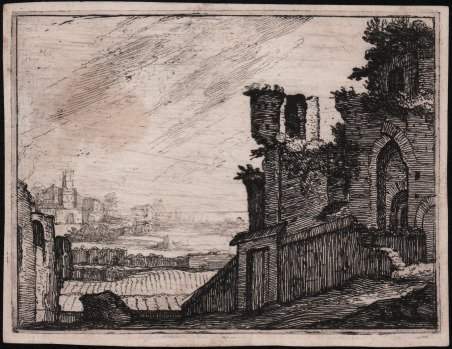
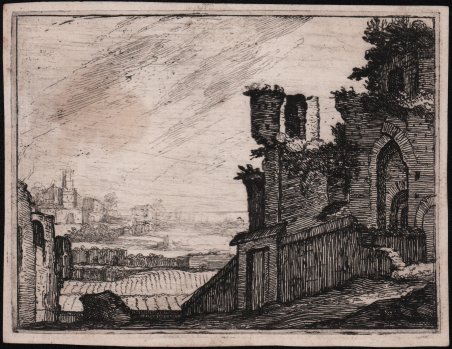
Palazzo dei Cesari
Payment methods
- PayPal
- Credit card
- Bank transfer
- Pubblica amministrazione
- Carta del Docente
Details
- Year of publication
- 1629
- Size
- 127 X 93
- Engravers
- MERCATI Giovanni Battista
Description
PRIMO STATO, SCONOSCIUTO AI REPERTORI Acquaforte, 1629, firmata in lastra in basso. Esemplare di primo stato, avanti il numero ' 38 ' e il titolo ' Pallazo Maggiore ' aggiunti in alto. Magnifica prova, ricca di toni, impressa su carta vergata coeva, con sottilissimi margini, in perfetto stato di conservazione. ' La veduta appartiene all’importante raccolta ' Alcune vedute et prospettive di luoghi dishabitati di Roma, una serie di 52 incisioni del pittore ed incisore barocco Giovanni Battista Mercati. Bartsch e Rossetti non descrivono queste prove prima della numerazione e del testo. Nel frontespizio della raccolta in nostro possesso – purtroppo non completa delle 52 tavole che per questo motivo vengono offerte individualmente – troviamo in basso a destra l’indicazione del privilegio, il ' Superior permissu, mentre manca l’iscrizione ' Cum privilegio Regio ' che si riscontra in tutti gli altri esemplari della raccolta esaminati, come ad esempio questo del British Museum: https://www.britishmuseum.org/collection/object/P_1868-0822-8618 “In 1629 Mercati published a series of fifty etched views of Rome which were dedicated to Ferdinand de' Medici. His approach was remarkably innovative. Unlike many earlier view prints of Rome which, like Falda's later ones, emphasized architectural accuracy and were essentially documents and records, Mercati's etchings anticipated Piranesi's more evocative, romantic approach. Mercati's views are delightfully informal, picturesque, and impressionistic. The prints are small and intimate, and the buildings and monuments are often seen from odd points of view. The artist was as concerned with space — empty places (luoghi dishabitati) — and with the light and shadow that fill them as he was with the monuments themselves. His etchings give a vivid sense of the city as it would be glimpsed by someone rambling behind the scenes. Their execution was similarly free and casual, with the etched lines sketchily rendered and stop-out varnish freely and expertly applied to lighten the far distance and to "paint in" bright highlights in the foreground. Especially effective was Mercati's stopping out of a wall seen through the most distant archway, making it look as if its solidity had been bleached away by the sun. The irregular, quivering lines and the intense passages of light and dark give the impression of forms and spaces vibrating in sunlight, flickering with light and shadow. The irregular, frayed quality of the darkest shading lines also evokes the worn, eroded surfaces of the ruins, which seem to be crumbling away before the viewer's eyes. In addition to his knowledge of the etchings of Ventura Salimbeni and Raffaello Schiaminossi, Mercati must also have been aware of similar approaches to views and landscape seen in the prints of Jacques Callot, Stefano della Bella, and Israel Silvestre. In this context it is interesting that Giovanni Battista Falda was strongly influenced by the same three artists, but he assimilated their approach in a way almost the opposite of Mercati's, achieving great clarity and order in the rendering of line and tone” (cfr. Richard Wallace in ' Italian Etchers in the Reinassance & Barocque, pp. 160-162). Nato a Sansepolcro in Toscana nel 1591 e morto nel 1645, dopo un apprendistato presso il conterraneo Raffaello Schiaminossi finì col trasferirsi a Roma, che certo offriva più occasioni di lavoro, e fu membro dell'Accademia di San Luca. Autore di qualche disegno noto, di alcuni quadri sacri e di un piccolo manipolo di stampe d'invenzione o di traduzione (da sculture classiche o da dipinti di Correggio e di Pietro da Cortona), risulta in qualche relazione con personaggi della Roma barberiniana, a cui dedica le sue incisioni. Per citarne solo alcuni, Cassiano Dal Pozzo, Marcello Sacchetti, il cardinal nipote Antonio Barberini, Paolo Giordano II Orsini duca di Bracciano, e infine Francesco Borromini. Specialmente strette appaiono le sue amicizie con i tosc. UNKNOWN FIRST STATE Etching, 1629, signed in plate at bottom. First state, before the number ' 38 ' and title ' Pallazo Maggiore ' added at top. Magnificent proof, rich in tone, printed on contemporary laid paper, with very thin margins, in perfect condition. ' The view belongs to the important collection ' Alcune vedute et prospettive di luoghi dishabitati di Roma, a series of 52 engravings by the baroque painter and engraver Giovanni Battista Mercati. Bartsch and Rossetti do not describe these proofs before the numbering and text. In the frontispiece of the collection in our possession - unfortunately not complete with the 52 plates that for this reason are offered individually - we find at the bottom right the indication of the privilege, the ' Superior permissu, ' while the inscription ' Cum privilegio Regio ' is missing, which is found in all the other exemplars of the collection examined, such as this one in the British Museum: https://www.britishmuseum.org/collection/object/P_1868-0822-8618 “In 1629 Mercati published a series of fifty etched views of Rome which were dedicated to Ferdinand de' Medici. His approach was remarkably innovative. Unlike many earlier view prints of Rome which, like Falda's later ones, emphasized architectural accuracy and were essentially documents and records, Mercati's etchings anticipated Piranesi's more evocative, romantic approach. Mercati's views are delightfully informal, picturesque, and impressionistic. The prints are small and intimate, and the buildings and monuments are often seen from odd points of view. The artist was as concerned with space — empty places (luoghi dishabitati) — and with the light and shadow that fill them as he was with the monuments themselves. His etchings give a vivid sense of the city as it would be glimpsed by someone rambling behind the scenes. Their execution was similarly free and casual, with the etched lines sketchily rendered and stop-out varnish freely and expertly applied to lighten the far distance and to "paint in" bright highlights in the foreground. Especially effective was Mercati's stopping out of a wall seen through the most distant archway, making it look as if its solidity had been bleached away by the sun. The irregular, quivering lines and the intense passages of light and dark give the impression of forms and spaces vibrating in sunlight, flickering with light and shadow. The irregular, frayed quality of the darkest shading lines also evokes the worn, eroded surfaces of the ruins, which seem to be crumbling away before the viewer's eyes. In addition to his knowledge of the etchings of Ventura Salimbeni and Raffaello Schiaminossi, Mercati must also have been aware of similar approaches to views and landscape seen in the prints of Jacques Callot, Stefano della Bella, and Israel Silvestre. In this context it is interesting that Giovanni Battista Falda was strongly influenced by the same three artists, but he assimilated their approach in a way almost the opposite of Mercati's, achieving great clarity and order in the rendering of line and tone” (cfr. Richard Wallace in ' Italian Etchers in the Reinassance & Barocque, pp. 160-162). Born in Sansepolcro in Tuscany in 1591 and died in 1645, after an apprenticeship with fellow countryman Raffaello Schiaminossi he eventually moved to Rome, which certainly offered more work opportunities, and was a member of the Academy of San Luca. Author of some known drawings, some sacred paintings and a small handful of prints of invention or translation (from classical sculptures or paintings by Correggio and Pietro da Cortona), is in some relationship with characters of Barberini's Rome, to which he dedicated his engravings. To name but a few, Cassiano Dal Pozzo, Marcello Sacchetti, his cardinal nephew Antonio Barberini, Paolo Giordano II Orsini Duke of Bracciano, and finally Francesco Borromini. Especially close appear his friendships with the Tuscans, to whom he will be linked affinity of geog. Cfr.
