Recentis Romae ichnographia et hypsographia sive planta et facies ad magnificentiam.
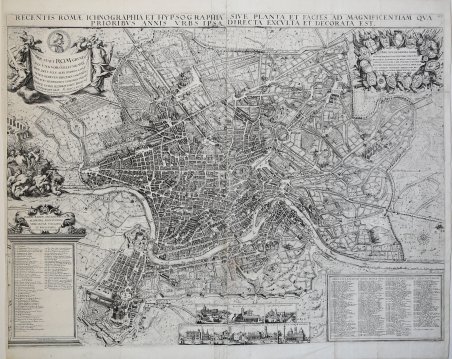
Recentis Romae ichnographia et hypsographia sive planta et facies ad magnificentiam.
Payment methods
- PayPal
- Credit card
- Bank transfer
- Pubblica amministrazione
- Carta del Docente
Details
- Year of publication
- 1677
- Place of printing
- Norimberga
- Size
- 860 X 650
- Engravers
- SANDRART Joachim von
- Keyword
- Piante e Panorami di Roma
Description
Grande pianta della città, stampata su due fogli reali, copia di quella realizzata da Giovan Battista Falda nel 1667 per papa Alessandro VII. Pianta a proiezione mista, orientata con il nord a sinistra. Topograficamente la carta del Sandrart è fedele a quella del Falda; le modifiche sostanziali sono nei cartigli, con le scritte in tedesco, e nella dedica a papa Innocenzo XI. Il cartiglio di destra raffigura gli stemmi dei Rioni, mentre in basso al centro sono incise delle piccole vedute delle sette chiese giubilari. Incisa a quattro mani con Johannes Meyer, questa pianta risulta per l’eleganza del segno, più raffinata rispetto al Falda, intagliata dal francese Lhuiler. “Copia della pianta piccola del Falda incisa dal Meyer che si firma in basso a sinistra ' Iohann Meyer fecit Tiguri. ' IN alto a sinistra, in luogo della dedica fatta dal Falda ad Alessandro VII, compare quella ad Innocenzo XI (1676-89) con la data 1677 e più in basso il nome di ' Ioachini Sandrart. La pianta è probabilmente anche contenuta nell'opera del Sandrart ' Der Alten und neue, pubblicata a Norimberga nel 1768” (cfr. Marigliani, p. 219). Esemplare fresco e brillante di questa rara versione dell'importante pianta di Roma in due fogli di Giovanni Battista Falda (1643-78) del 1667 (detta pianta piccola). “La pianta piccola di Falda ebbe un successo immediato: Una delle mappe più copiate e durature del primo periodo moderno” (Maier, p. 196), servì da modello per la sua famosa pianta grande in 12 fogli (Nuova pianta et alzata della città di Roma) del 1676. Il disegno di Falda fu “ampiamente acclamato come la più completa e accurata documentazione visiva della Roma barocca” (Maier, p. 165). La sua mappa in 12 fogli “apparve in cinque edizioni per un periodo di ottant'anni, la sua celebrità fu eclissata solo dall'apparizione della grande pianta di Giovanni Battista Nolli nel 1748. La pianta piccola originale del 1667 era basata su quella dell'incisore tedesco Mattheus Greuter e celebrava gli interventi urbanistici di papa Alessandro VII (1655-77). Un indice lungo il lato destro descrive i numerosi progetti del papa, visibili nel tessuto della città, e le personificazioni in alto a sinistra trasmettono il messaggio che sotto il papa Chigi la religione ha vinto l'eresia e l'architettura ha sconfitto il tempo” (McPhee, pp. 8, 10). Nella parte sinistra di questa pianta piccola del 1667 sono raffigurate le personificazioni delle fonti d'acqua di Roma e nella parte inferiore le vedute delle Sette Chiese, le principali chiese di pellegrinaggio di Roma. Acquaforte, con margini, in eccellente stato di conservazione. Rara. Bibliografia Huelsen (1915): n. 119; Scaccia Scarafoni (1939): n. 200; A. P. Frutaz, Le piante di Roma, CLVI ; TIB p. 317, 281 C1. C. Marigliani, Le Piante di Roma delle collezioni private, tav. 126; S. McPhee, “Falda’s Map as a Work of Art,” ' The Art Bulletin, vol. 101, no. 2 (2019), pp. 7-28; J. Maier, ' Rome Measured and Imagined: Early Modern Maps of the Eternal City. Large plan of the city, printed on two real sheets, copy of the one made by Giovan Battista Falda in 1667 for Pope Alexander VII. ' Mixed projection map, oriented with north on the left. Topographically, Sandrart's map is faithful to Falda's; the substantial changes are in the cartouches, with the German inscriptions, and in the dedication to Pope Innocezo XI. The right-hand cartouche depicts the coats of arms of the Rioni, while small views of the seven Jubilee churches are engraved in the bottom centre. Engraved by four hands with Johannes Meyer, this plan is more refined in the elegance of its sign than the Falda, carved by the Frenchman Lhuiler. "Copy of Falda's small plan engraved by Meyer, signed at lower left Iohann Meyer fecit Tiguri. In the upper left corner, instead of the dedication made by Falda to Alexander VII, the dedication to Innocent XI (1676-89) appears with the date 1677 and lower down the name of Ioachini Sandrart. The plan is probably also contained in Sandrart's work Der Alten und neue, published in Nuremberg in 1768' (cf. Marigliani p. 219). A fresh and bright example of this rare separately issued version of Giovanni Battista Falda’s (1643-78) important 1667 two-sheet plan of Rome (called the ' pianta piccola). “Falda’s ' pianta piccola ' was an instant success: One of the most frequently and enduringly copied maps of the early modern period” (Maier, p. 196), it served as the model for his famed 12-sheet ' pianta grande ' (Nuova pianta et alzata della città di Roma) of 1676. Falda’s design was “widely acclaimed as the most complete and accurate visual record of baroque Rome” (Maier, p. 165). His 12-sheet map “appeared in five editions over a period of eighty years, its celebrity eclipsed only by the appearance of Giovanni Battista Nolli’s great plan in 1748. The original 1667 ' pianta piccola ' was indebted to the German etcher Greuter and celebrated the urban interventions of Pope Alexander VII (r. 1655-77). An index along the right side details the pope’s many projects, visible in the fabric of the city, and personifications at the upper left convey the message that under the Chigi pope, Religion had conquered Heresy and Architecture has defeated Time” (McPhee, pp. 8, 10). Inset at the left of this 1667 ' pianta piccola ' are personifications of Rome’s water sources and inset at the bottom are views of the ' Sette Chiese, Rome’s principal pilgrimage churches. Etching, with margins, in excellent condition. Rare. Bibliografia Huelsen (1915): n. 119; Scaccia Scarafoni (1939): n. 200; A. P. Frutaz, Le piante di Roma, CLVI ; TIB p. 317, 281 C1. C. Marigliani, Le Piante di Roma delle collezioni private, tav. 126; S. McPhee, “Falda’s Map as a Work of Art,” ' The Art Bulletin, vol. 101, no. 2 (2019), pp. 7-28; J. Maier, ' Rome Measured and Imagined: Early Modern Maps of the Eternal City. Cfr.
