Ritratto di Mehdi Quli Beg
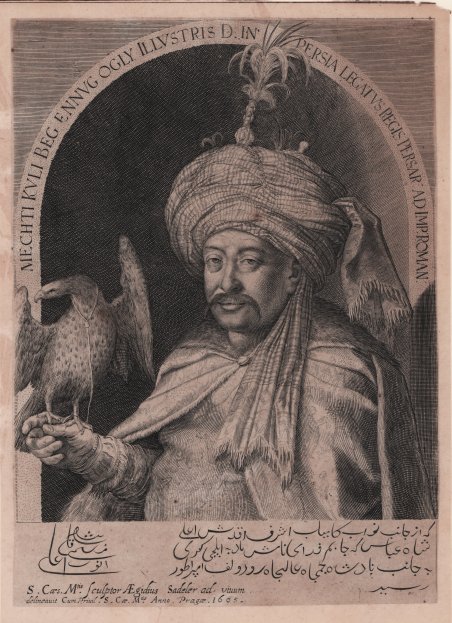
Ritratto di Mehdi Quli Beg
Payment methods
- PayPal
- Credit card
- Bank transfer
- Pubblica amministrazione
- Carta del Docente
Details
- Year of publication
- 1605
- Size
- 180 X 291
- Engravers
- SADELER Aegidius II
- Keyword
- Ritratti
- Inscription description
- Hollstein 275.I
Description
Bulino, 1605, iscrizioni in persiano e latino, "Mechti Kvli Beg Ennvg Ogly Illvstris D. In Persia Legatvs Regis Persar: Ad Imp: Roman" e “S.Caes. Mti.s scultore Aegidius Sadeler ad vivum delineauit Cum Privil.S.Cae. Mti.s Anno. Pragae.1605”. ' Primo stato, avanti l’indirizzo editoriale. Buon esemplare, stampato su carta vergata coeva, applicato su antico supporto di carta da collezione, rifilato ai margini, occasionale foxing, altrimenti in ottime condizioni. Ritratto inciso di Mehdi Quli Beg (d. 1629), ambasciatore di Shah Abbas I presso la corte di Rodolfo II del Sacro Romano Impero. Engraving, 1605, lettered in Persian and Latin, “Mechti Kvli Beg Ennvg Ogly Illvstris D. In Persia Legatvs Regis Persar: Ad Imp: Roman”, (Mehdi Quli Beg, son of Ennug, a famous lord in Persia, ambassador of the King of the Persians to the Roman Emperor), and “S.Caes. Mti.s Sculptor Aegidius Sadeler ad viuum delineauit Cum Privil.S.Cae. Mti.s Anno. Pragae.1605”. ' First state before publisher's address. Good example, printed on contemporary laid paper, applied on collector’s old paper support, trimmed at margins, occasional foxing, otherwise very good condition. ' Engraved portrait of Mehdi Quli Beg (d. 1629), ambassador of Shah Abbas I to the court of the Holy Roman Emperor Rudolf II, half-length and slightly turned to left, a bird (probably a falcon) perched on his right hand, in oriental dress and wearing a turban. Zeynal Khan Shamlu, and later, Mehdi Quli Beg, were amongst seven ambassadors sent by Shah 'Abbas to European courts, as part of his attempt to enlist Christian cooperation in confronting the Ottomans with a multi-front threat. The ongoing war in Hungary had led to financial strains, internal revolts and a decline in loyalty of Ottoman troops; to 'Abbas these troubles signalled that the Ottoman adversary had been weakened to the point where his revived Persian army could reclaim the territory lost in the previous war. Zeynal Khan Shamlu departed in mid-1603 and arrived in Prague on 19th July 1604 to much fanfare. He and his party of 30 servants were given an escort of over one thousand men, mounted and on foot. Mehdi Quli Beg arrived later, in December, updating Rudolf on the situation. After endless debate and vacillation, Rudolf elected to begin peace negotiations with the Ottomans. All this meant that the Persian ambassadors were fixtures in Prague until October 1605, and were doubtless regarded as exotic figures (which is obvious from the insistence on using Persian for the prints, which no one in Prague could read and which would have taken some effort to reproduce). Cfr. Hollstein 275.I
