Sacra Famiglia di Francesco I
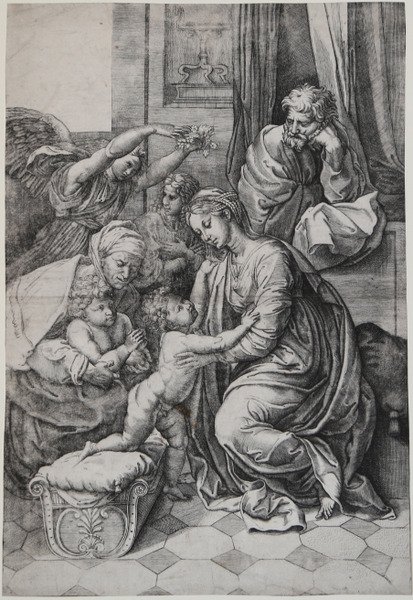
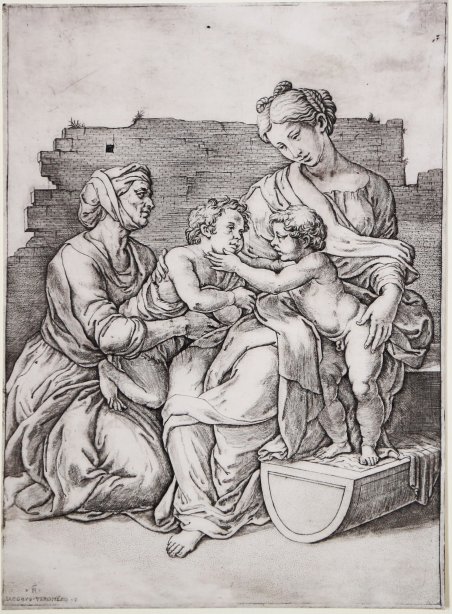
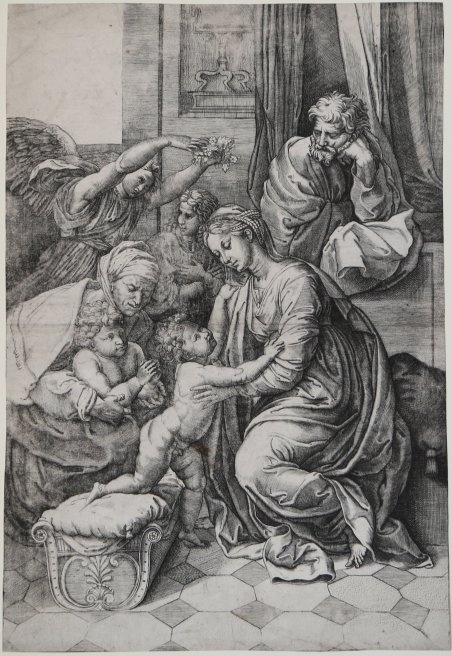
Sacra Famiglia di Francesco I
Payment methods
- PayPal
- Credit card
- Bank transfer
- Pubblica amministrazione
- Carta del Docente
Details
- Year of publication
- 1520
- Size
- 425 X 287
- Engravers
- CARAGLIO Gian Jacopo
Description
Bulino, 1520 circa, privo di firma e data. Esemplare nel primo stato di due, avanti i tratti aggiuntivi e le inziali R V.Bellissima prova, impressa su carta vergata coeva, rifilata alla linea marginale, piega centrale visibile al verso, in ottimo stato di conservazione.Il soggetto riproduce a stampa, in controparte, il famoso dipinto di Raffaello, oggi conservato al Louvre (inv. 604). Eseguito per ‘il Cristianissimo’ Re di Francia Francesco I. Nel 1518, Raffaello ricevette l'incarico di dipingere La Sacra Famiglia da Papa Leone X e suo nipote, Lorenzo II de Medici, duca di Urbino, per essere offerto in dono a Claudia, la regina di Francia, moglie di Francesco I. Dipinto in soli due mesi, aprile e maggio, fu consegnato alla fine di maggio e, sebbene firmato e datato da Raffaello, si ritiene che vi sia un contributo importante dei suoi assistenti, in particolare di Giulio Romano. Insieme a questo dipinto per la regina di Francia, i Medici commissionarono anche un San Michele Arcangelo (anch’esso al Louvre) destinato ad essere offerto in dono a Francesco I.Si ritiene, tuttavia, che l’incisione del Caraglio abbia avuto come modello i disegni preparatori, piuttosto che il dipinto stesso. Si conservano quattro disegni preparatori, uno al Louvre, due agli Uffici e un quarto a Bayinne, la cui attribuzione a Raffello è discussa. Bibliografia Passavant 1860, vol. II, p. 258; Le Blanc I.587.5; Gori Gandellini 1808-1816, VIII.44.3; Raphael Invenit, no. XXXII.1; Bianchi, La Fortuna di Raffaello, p. 674, e 687, nota 246; Bilbao Fine Arts Museum, no. 2, 2007, pp. 17-64. Engraving, 1520 circa, not dated or signed. Example in the first state of two, before the letters 'R V'.Magnificient proof, printed on contemporary laid paper, trimmed close to platemark, central fold visible on the back, otherwise very good condition.The compositione derives, in reverse, from the Raphael painting (today in the Louvre, inv. no. 604). In 1518, he received the commission to paint The Holy Family from Pope Leo X and his nephew, Lorenzo II de Medici, duke of Urbino, to be offered as a gift to Claude, the Queen Consort of France, wife of Francis I. Painted in just two months, April and May, it was delivered at the end of May and, although signed and dated by Raphael, his assistants, particularly Giulio Romano, mentioned by Vasari, are considered to have done a lot of work on it. Raphael, despite his exceptional ca¬pacity for work, had a heavily manned workshop to deal with his rapidly increasing commitments. Together with this painting for the Queen of France, the Medici also commissioned a Saint Michael, Archangel (The Louvre) destined to be offered as a gift to Francis I. Four of these drawings survive, one held in the Louvre, Young Woman with Her Arms out to a Child, and two in the Uffizi, Child and Study for a Virgin with the Child. Raphael’s authorship of these three drawings is by no means wholly accepted, as some researchers believe them to be the work of of Giulio Romano. And, finally, the collection of the Bonnat Museum in Bayonne (France) includes the Head of Saint Joseph, a beautiful fragment of the preparatory card for the figure of the saint.According to Massari, the second state bears the letters 'R V' referring to the inventor. Bibliografia Passavant 1860, vol. II, p. 258; Le Blanc I.587.5; Gori Gandellini 1808-1816, VIII.44.3; Raphael Invenit, no. XXXII.1; Bianchi, La Fortuna di Raffaello, p. 674, e 687, nota 246; Bilbao Fine Arts Museum, no. 2, 2007, pp. 17-64. Cfr.
