Sacra Famiglia
Sacra Famiglia | Prints | HOPFER Hieronimus
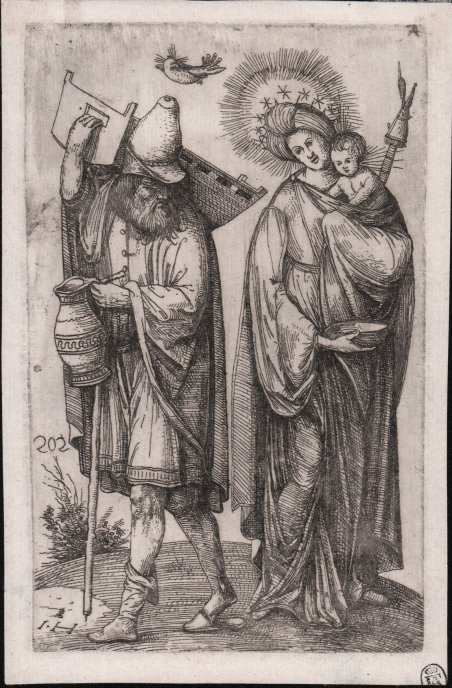
Sacra Famiglia
Sacra Famiglia | Prints | HOPFER Hieronimus
Payment methods
- PayPal
- Credit card
- Bank transfer
- Pubblica amministrazione
- Carta del Docente
Details
- Year of publication
- 1530
- Size
- 84 X 135
- Engravers
- HOPFER Hieronimus
Description
Acquaforte su ferro, monogrammata in lastra in basso a sinistra 'I.H'. Derivazione, in controparte, dell’opera di Jacopo de’ Barbari (Hind 16 & 17). Esemplare nel secondo stato di due, con il numero “202” aggiunto sul lato sinistro. Hieronymus Hopfer (Augusta, 1500 circa – Norimberga, dopo il 1550) nacque intorno al 1500 come secondo figlio di Daniel Hopfer. Solo pochi dati biografici sono noti: nel 1529 il Consiglio della città di Augusta gli permise di andare a Norimberga per un anno mentre, nel 1531, Hopfer rinunciò completamente ai suoi tradizionali diritti civili e dopo il 1550 morì a Norimberga. La maggior parte delle opere conosciute sono copie basate su xilografie e incisioni di artisti tedeschi (Dürer, Cranach) e italiani (Barberi, Campagnola, Mantegna), nonché incisioni basate su medaglie e rilievi. Contrariamente al Dürer e agli altri maestri del bulino di Norimberga, Hieronimus Hopfer era solito realizzare le proprie incisioni all’acquaforte e su lastra di ferro anziché di rame, tecnica nella quale era uno specialista insieme agli altri esponenti della famiglia di incisori, il padre Daniel e il fratello Lambert Hopfer. Tecnica nuova per la stampa (anche se utilizzata da tempo per decorare i metalli), l'acquaforte consisteva nell'incidere le linee su una lastra di ferro con l'acido anziché raschiarle con il bulino. La prima stampa sopravvissuta di questa tecnica su ferro, opera di Urs Graf, risale al 1513. Magnifica prova, impressa con tono su carta vergata coeva, con margini, in perfetto stato di conservazione. Ex collezione: Frederick Augustus of Saxony (Lugt 971); Ines Beckendorf Kaps (Lugt 3575); Ines Kaps (Lugt 3551); Collezione non identificata (Lugt 5176). Bibliografia Hollstein, German engravings, etchings and woodcuts c.1400-1700 (6.II); Bartsch, Le Peintre graveur (VIII.507.4). Holy Family; the Virgin and Christ Child with a distaff on right, Joseph with a cradle, jug and staff standing on left, a dove above Joseph's head. Etching of iron, monogrammed on plate at the bottom left 'I.H'. Derivation, in reverse, the work of Jacopo de 'Barbari (Hind 16 & 17). Example in the second state of two, with the added number “202” at the left edge. Hieronymus Hopfer (Augsburg, c. 1500 - Nuremberg, after 1550) was born around 1500 as the second son of Daniel Hopfer. Only few biographical data are known: in 1529 the Augsburg City Council allowed him to go to Nuremberg for a year while, in 1531, Hopfer completely renounced his traditional civil rights and after 1550 he died in Nuremberg. Most of the known works are copies based on woodcuts and engravings by German (Dürer, Cranach) and Italian (Barberi, Campagnola, Mantegna) artists, as well as engravings based on medals and reliefs. Unlike Dürer and the other Nuremberg masters of engraving, Hieronimus Hopfer used to make his works in etching and on iron plate rather than copperplate, a technique in which he was a specialist along with the other members of the engraving family, his father Daniel and brother Lambert Hopfer. The new technique in printmaking (although long used to decorate metalwork), etching involved biting lines into an iron plate with acid rather than scraping them with a burin. The earliest surviving print in the technique - by Urs Graf - dates from 1513. Dürer’s brief experimentation with this form of printmaking, between 1515 and 1518, does not appear to have proved particularly satisfying to him, and he soon concentrated on engraving, his preferred method of incising a plate. Magnificent proof, printed with tone on contemporary thin paper, with margins, in good condition. Collection's marks on recto and verso: Frederick Augustus of Saxony (Lugt 971); Ines Beckendorf Kaps (Lugt 3575); Ines Kaps (Lugt 3551); Collezione non identificata (Lugt 5176). Bibliografia Hollstein, German engravings, etchings and woodcuts c.1400-1700 (6.II); Bartsch, Le Peintre graveur (VIII.507.4) Cfr.