San Girolamo nello studio
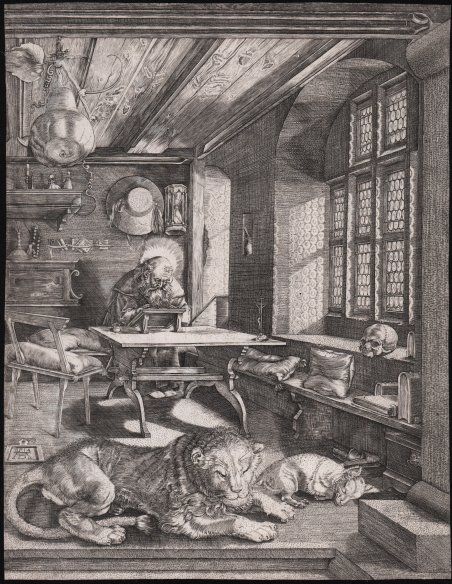
San Girolamo nello studio
Payment methods
- PayPal
- Credit card
- Bank transfer
- Pubblica amministrazione
- Carta del Docente
Details
- Year of publication
- 1550
- Size
- 185 X 240
- Engravers
- Anonimo
Description
San Girolamo nel suo studio; San Girolamo seduto a scrivere su uno scrittoio illuminato dal sole, con un leone e un cane in primo piano. Bulino, circa 1550, copia in controparte della celebre incisione di Albrecht Durer datata 1514. Magnifica prova, ricca di toni, impressa su carta vergata coeva, minimi restauri agli angoli visibili al verso, per il resto in ottimo stato di conservazione. Dürer si dedicava spesso al tema di San Girolamo, per predilezione o per la popolarità del santo. Per dimensioni, data e qualità, questa incisione è stata raggruppata con "Cavaliere Morte e Diavolo" (B. 098) e "Melencolia I" (B. 074). Sono state avanzate diverse ipotesi su una relazione ancora più stretta tra queste tre stampe considerate come una serie incompleta dei quattro temperamenti e rappresentanti le tre virtù, “intellectuales, morales, et theologicales". Il 'San Girolamo' e il 'Cavaliere Morte e Diavolo' simboleggiano la vita contemplativa e la vita attiva, e sebbene rappresentino due metodi opposti per raggiungere un obiettivo comune, il 'San Girolamo' e la 'Melencolia' esprimono due ideali antitetici. Tuttavia, durante il suo viaggio nei Paesi Bassi, Dürer non donò mai tutte e tre queste incisioni come un insieme, ma occasionalmente il "San Girolamo" e la "Melencolia" come coppia. Un evento storico è stato citato come prova di una particolare relazione di queste due ultime stampe: nel 374 d.C. San Girolamo ebbe una visione che gli fece abbandonare le litterae seculares per le litterae divinae. La costruzione prospettica della camera del 'San Girolamo' è stata più volte analizzata e talvolta criticata perché distorta. Il Crocifisso sul tavolo è in linea visiva diretta tra il santo e il teschio, quest'ultimo simbolo di caducità. La zucca, sospesa al soffitto, fa riferimento a una controversia tra i santi Girolamo e Agostino sulla corretta traduzione della parola ebraica kikayon (Giona 4,6). Girolamo sosteneva che la parola significava edera (hedera), non zucca (curcurbita). La mezza finestra nell'angolo posteriore è stata considerata un riferimento all'insegnamento di San Paolo secondo cui l'uomo vede solo un riflesso di Dio, la cui vera gloria rimane nascosta in una nube di incoscienza. Bibliografia The Illustrated Bartsch p. 140, 060, C7; J. Heller, Das Leben un die Werke Albrecht Durer, n. 762. St. Jerome in his study; St. Jerome seated writing at a sunlit writing desk, with a lion and a dog in the foreground. Engraving, ca. 1550, a mirror copy of Albrecht Durer's famous engraving dated 1514. Magnificent proof, rich in tone, printed on contemporary laid paper, minimal corner restorations visible on verso, otherwise in excellent condition. Dürer often devoted himself to the theme of St. Jerome, either out of predilection or because of the saint's popularity. By size, date, and quality, this engraving has been grouped with "Knight Death and Devil" (B. 098) and "Melencolia I" (B. 074). Several hypotheses have been advanced about an even closer relationship between these three prints considered as an incomplete series of the four temperaments and representing the three virtues, "intellectuales, morales, et theologicales". The 'Saint Jerome' and the 'Knight Death and Devil' symbolize the contemplative life and the active life, and although they represent two opposite methods of achieving a common objective, the 'Saint Jerome' and the 'Melencolia' express two antithetical ideals. However, during his trip to the Netherlands, Dürer never donated all three of these engravings as a whole, but occasionally the 'Saint Jerome' and the 'Melencolia' as a pair. One historical event has been cited as evidence of a special relationship of these last two prints: in 374 CE. St. Jerome had a vision that made him abandon litterae seculares for litterae divinae. The perspective construction of the room of 'St. Jerome' has been repeatedly analyzed and sometimes criticized for being distorted. The crucifix on the plate is in a direct visual line between the saint and the skull, the latter a symbol of transience. The gourd, suspended from the ceiling, refers to a dispute between saints Jerome and Augustine over the correct translation of the Hebrew word “kikayon” (Jonah 4:6). Jerome argued that the word meant ivy (hedera), not gourd (curcurbita). The half-window in the back corner was considered a reference to St. Paul's teaching that man sees only a reflection of God, whose true glory remains hidden in a cloud of unconsciousness. Bibliografia The Illustrated Bartsch p. 140, 060, C7; J. Heller, Das Leben un die Werke Albrecht Durer, n. 762. Cfr.
