Sphaerarum Artificialium Typica Repraesentatio
Sphaerarum Artificialium Typica Repraesentatio
Payment methods
- PayPal
- Credit card
- Bank transfer
- Pubblica amministrazione
- Carta del Docente
Details
- Year of publication
- 1720
- Place of printing
- Norimberga
- Size
- 590 X 490
- Engravers
- HOMANN Johann Baptist
- Keyword
- Carte Celesti
Description
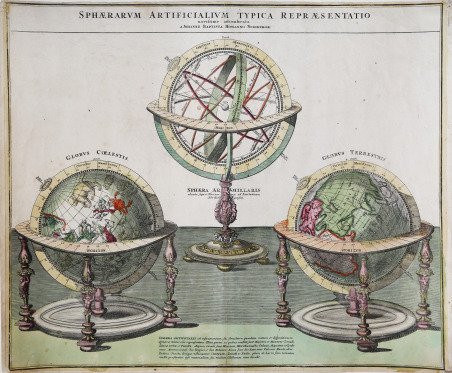
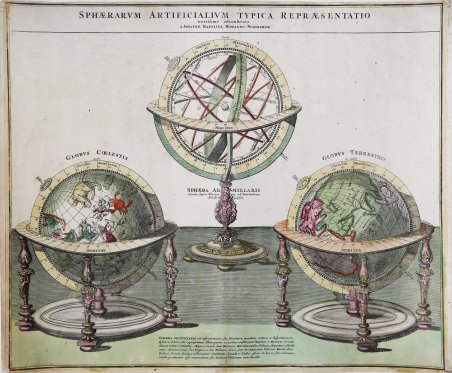
Questa elegante incisione proviene da uno degli atlanti celesti di Homann. Illustra una coppia di globi terrestri e celesti e una sfera armillare abbinata, tutti su supporti da biblioteca del periodo barocco. La sfera armillare è un modello della sfera celeste, costituito da una struttura sferica di anelli, centrati sulla Terra, che rappresentano le linee di longitudine e latitudine celesti e l'eclittica. Il globo terrestre mostra l'Asia, l'Europa e l'Africa, mentre quello celeste mostra varie costellazioni con figure secondo la mitologia greca. Ognuno dei supporti barocchi incorpora elementi di cariatide nei supporti, insieme ad altri ornamenti classici. Johann Baptist Homann è stato un geografo e cartografo tedesco; nel 1702 fondò la sua casa editrice. Homann acquisì fama come uno dei principali cartografi tedeschi, e nel 1715 fu nominato geografo imperiale dall'imperatore Carlo VI. Nello stesso anno fu anche nominato membro dell'Accademia Prussiana delle Scienze a Berlino. Nel 1716 Homann pubblicò il suo capolavoro ' Grosser Atlas ueber die ganze Welt. Numerose mappe furono redatte in collaborazione con l'incisore Christoph Weigel. Homann morì a Norimberga nel 1724. Gli successe suo figlio Johann Christoph (1703-1730). L'azienda continuò dopo la sua morte come azienda degli eredi Homann, gestita da Johann Michael Franz e Johann Georg Ebersberger. Dopo successivi cambiamenti nella gestione, l'azienda si sciolse nel 1852. ' Incisione su rame, coloritura coeva, in ottimo stato di conservazione. This elegant engraving is from one of Homann's celestial atlases. It illustrates a pair of terrestrial and celestial globes and a matching armillary sphere, all on Baroque library stands. The armillary sphere is a model of the celestial sphere, consisting of a spherical framework of rings, centered on Earth, that represent lines of celestial longitude and latitude and the ecliptic. The terrestrial globe shows Asia, Europe and Africa and the celestial shows various constellations with figures according to Greek mythology. Each of the Baroque stands incorporates caryatid elements in the supports, together with other classical ornamentation. Johann Baptist Homann was a German geographer and cartographer; in 1702 he founded his own publishing house. Homann acquired renown as a leading German cartographer, and in 1715 was appointed Imperial Geographer by Emperor Charles VI. In the same year he was also named a member of the Prussian Academy of Sciences in Berlin. In 1716 Homann published his masterpiece ' Grosser Atlas ueber die ganze Welt; numerous maps were drawn up in cooperation with the engraver Christoph Weigel the Elder. Homann died in Nuremberg in 1724 and was succeeded by his son Johann Christoph (1703-1730). The company carried on upon his death as Homann Heirs company, managed by Johann Michael Franz and Johann Georg Ebersberger. After subsequent changes in management the company folded in 1852. ' Copper engraving, original hand colours, in excellent condition. Cfr.
