Details
Engravers
LINNIG William II
Description
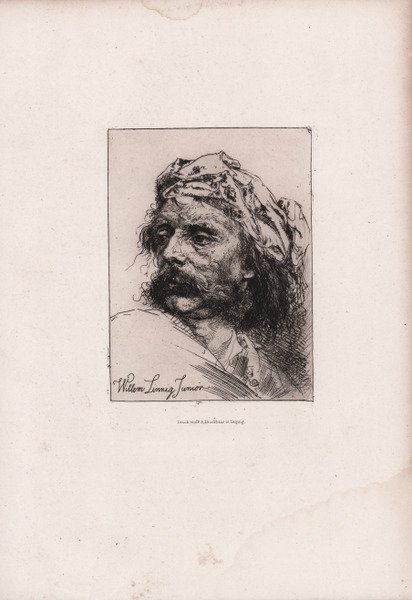
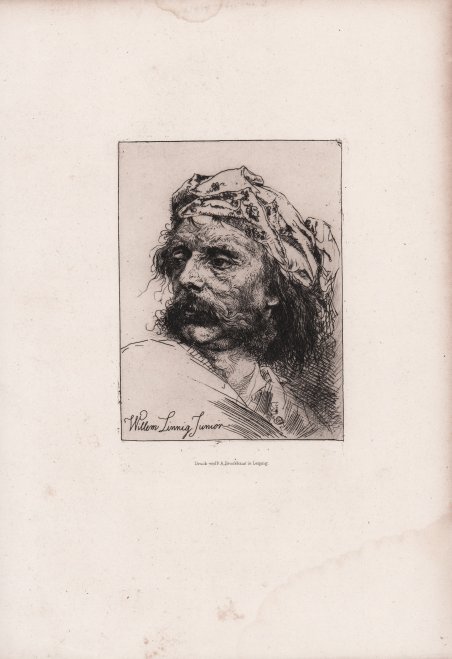
Studio di una testa d'uomo con turbante; prova firmata. Acquaforte e puntasecca con tono di superficie. Firmata all'interno dell'immagine in basso a sinistra: "Willem Linnig Junior". Dalla serie di acqueforti per il 1881 pubblicata dalla Gesellschaft für Radierkunst zu Weimar (la Società degli incisori di Weimar) Una bella impressione, stampata su carta contemporanea, con margini, macchia d'acqua al margine inferiore destro, altrimenti buone condizioni. Willem Linnig il Giovane (20 agosto 1842, ad Anversa - 3 settembre 1890, ad Anversa) è stato un pittore e incisore belga, meglio conosciuto per le sue scene storiche e di genere, paesaggi e nature morte. Conosciuto come "Il Giovane", nacque ad Anversa come figlio di Willem Linnig il Vecchio. ' Linnig fu un pittore e stampatore molto prolifico. Ha lasciato un gran numero di dipinti e 123 incisioni. Lavorò su una vasta gamma di soggetti: storia e scene di genere, paesaggi e nature morte. Delle 123 acqueforti prodotte da Linnig, 122 erano di sua creazione e una era un'acquaforte riproduttiva delle Ninfe e Satiri di Rubens. Disegnò le linee con grande cura nel suo lavoro grafico, ma mostrò anche un grande livello di esuberanza. Le opere di Linnig sono state presentate in una mostra del 1991, con un catalogo a cura di P. Verbraeken Linnig: Ein Antwerpse kunstenaarsdynastie in de 19de eeuw. Il catalogo delle incisioni di Linnig non dà una corrispondenza precisa per questo lavoro. Suppongo che questo possa essere Linnig 67, Le contrabandier. Bibliografia P. Verbraeken, Linnig: Ein Antwerpse kunstenaarsdynastie in de 19de eeuw, n. 67. Study of a head of a man with turban; signed proof. Etching and drypoint with surface tone. Lettered within image in lower left corner: "Willem Linnig Junior". From the series of etchings for 1881 published by the Gesellschaft für Radierkunst zu Weimar (the Society of Etchers in Weimar) A fine impression, printed on contemporary wove paper, with margins, waterstain at the lower right margin, otherwise good condition. Willem Linnig the Younger (August 20, 1842, in Antwerp - September 3, 1890, in Antwerp) was a Belgian painter and engraver, best known for his historical and genre scenes, landscapes and still lifes. Known as "The Younger", he was born in Antwerp as the son of Willem Linnig the Elder. ' Linnig was a very prolific painter and printmaker. He left behind a large number of paintings and 123 etchings. He worked on a wide range of subjects: history and genre scenes, landscapes and still lifes. Of the 123 etchings Linnig produced, 122 were of his own design and one was a reproductive etching of Rubens' Nymphs and Satyrs. He drew the lines with great care in his graphic work, but also showed a great level of exuberance. Linnig came from a dynasty of celebrated Belgian artists, whose output was surveyed in a 1991 exhibition, with a catalogue by P. Verbraeken et. al., Linnig: Ein Antwerpse kunstenaarsdynastie in de 19de eeuw. The catalogue of Linnig's etchings in French does not give a precise match for this. I assume this may be Linnig 67, Le contrabandier, but have no proof. Bibliografia P. Verbraeken, Linnig: Ein Antwerpse kunstenaarsdynastie in de 19de eeuw, n. 67. Cfr.
 Find out how to use
 Find out how to use