Thes Palais Indiens
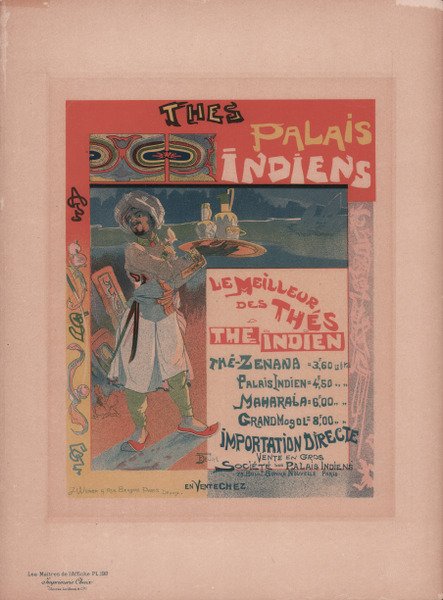
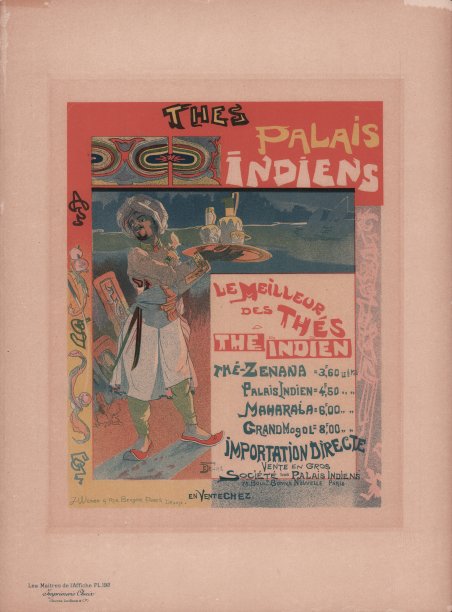
Thes Palais Indiens
Payment methods
- PayPal
- Credit card
- Bank transfer
- Pubblica amministrazione
- Carta del Docente
Details
- Year of publication
- 1900
- Size
- 290 X 400
- Engravers
- De Feure Georges
Description
Litografia stampata a colori su carta velina, in ottime condizioni. Tavola n° 199 del quinto volume annuale (1900) de Les Maîtres de l'affiche. Prova recante il timbro a secco de Les Maîtres de l'affiche nell'angolo in basso a destra (Lugt: L.1777c), firmata nella lastra, stampata a Chaix (Ateliers Chéret) rue Bergère a Parigi. Les Maîtres de l'affiche è una pubblicazione mensile francese stampata in Francia tra dicembre 1895 e novembre 1900. L'idea di realizzare la rivista è di Jules Chéret, all'epoca direttore artistico di Chaix, una stamperia situata a Parigi al nº 20 di rue Bergère. Ogni numero comprende quattro affiches riprodotte usando la tecnica di cromolitografia. Ogni copia aveva apposto un timbro a secco di autentificazione. Il prezzo di vendita è di 2,50 franchi a numero mentre l'abbonamento costa 27 franchi; esiste anche un'edizione di lusso sul Giappone stampata in 100 esemplari venduta a 80 franchi per 12 numeri. Nel gennaio 1897 viene messo in vendita un primo volume che riprende tutte le affiches pubblicate l'anno precedente; la pubblicazione ha una prefazione firmata da Roger Marx e ha un formato realizzato da Jean Engel su progetto di Paul Berthon. Fino a gennaio 1901, data di chiusura della rivista, sono stati realizzati un totale di cinque volumi, con 97 artisti coinvolti. Le 256 tavole a colori che compongono la suite rappresentano un'ampia selezione di eccezionali manifesti originali dell'inizio del ventesimo secolo, quando questa forma d'arte popolare raggiunse il suo apice. I primi manifesti stampati erano molto ricchi di testo, con relativamente poche illustrazioni. Dopo tutto, sono stati creati per pubblicizzare prodotti, e l'aggiunta di un'illustrazione a una pubblicità a metà del 1800 non era comune. Tuttavia, durante la seconda metà del diciannovesimo secolo, quando tutti i tipi di prodotti commerciali furono migliorati esteticamente, gli artisti seri cominciarono a vedere le nuove possibilità del mezzo poster. Collegando il loro immaginario al commercio moderno, il pensiero era che ognuno sarebbe stato valorizzato dal valore dell'altro. Questo fu particolarmente vero per Jules Cheret (1836-1932), la cui combinazione unica di talento artistico, tecnico e imprenditoriale aprì la strada a una vera e propria industria del poster. Cheret aprì la sua tipografia a Parigi nel 1866 - Imprimerie Chaix - e il suo lavoro iniziò a ispirare numerosi emulatori in tutta Europa e in America. Negli anni 1890 le strade di ogni grande città erano animate da grandi manifesti colorati. I manifesti non solo avevano catturato la fantasia del pubblico, ma i suoi migliori esempi venivano già considerati come vere e proprie opere d'arte (nello specifico, come belle stampe) da esporre, recensire nelle riviste, collezionare e riprodurre in una forma più maneggevole. Negli ultimi cinque anni del secolo, lo spirito esuberante della "Belle Epoque", diede vita a un nuovo movimento artistico. Fu in quegli anni che l'Imprimerie Chaix ebbe un ruolo importante nel codificare, santificare e perpetuare la visione di Cheret attraverso la stampa. ' Lithograph printed in color on tissue paper, in very good condition. Table n° 199 of the fifth annual volume (1900) of Les Maîtres de l'affiche. Proof with the embossed stamp of Les Maîtres de l'affiche in the lower right corner (Lugt: L.1777c), signed in the plate, printed at Chaix (Ateliers Chéret) rue Bergère in Paris. Les Maîtres de l'affiche is a monthly French publication printed in France between December 1895 and November 1900. The idea to create the magazine is of Jules Chéret, at the time artistic director of Chaix, a printing house located in Paris at 20 rue Bergère. Each issue includes four posters reproduced using the technique of chromolithography. Each copy had an embossed stamp of authentication. The sale price was 2.50 francs per issue, while a subscription cost 27 francs. There was also a luxury edition on Japan printed in 100 copies and sold for 80 francs for 12 issues. In January 1897, a first volume was put on sale that included all the affiches published the previous year; the publication had a preface signed by Roger Marx and had a format created by Jean Engel based on a project by Paul Berthon. Until January 1901, the date of the magazine's closure, a total of five volumes were produced, with 97 artists involved. ' The 256 color plates that make up the suite represent a wide-ranging selection of outstanding original posters from the turn of the twentieth century when this popular art form first reached its peak. Early printed posters were very text-heavy, with relatively few illustrations. After all, they were created to advertise products, and adding an illustration to an advertisement in the mid-1800s was not commonplace. However, during the second half of the nineteenth century, when all types of commercial products were aesthetically upgraded, serious artists began to see the new possibilities in the poster medium. By linking their imagery to modern commerce, the thinking was that each would be enhanced by the value of the other. This was especially true for Jules Cheret (1836-1932) whose unique combination of artistic, technical, and entrepreneurial talents paved the way for an actual poster industry. Cheret opened his own print shop in Paris in 1866 – Imprimerie Chaix – and his work then began to inspire numerous emulators throughout Europe and America. By the 1890s the streets of every great city were enlivened by large, colorful posters. The posters had not only caught the fancy of the public, but its best examples were already being regarded as true works of art (specifically, as fine prints) to be exhibited, reviewed in journals, and collected and reproduced in a more manageable form. In the last five years of the century, the ebullient spirit of the “Belle Epoque,” gave birth to a new artistic movement. It was during those years that Imprimerie Chaix was to play a significant part in codifying, hallowing, and perpetuating Cheret’s vision through printmaking. Cfr.
