Un guerriero
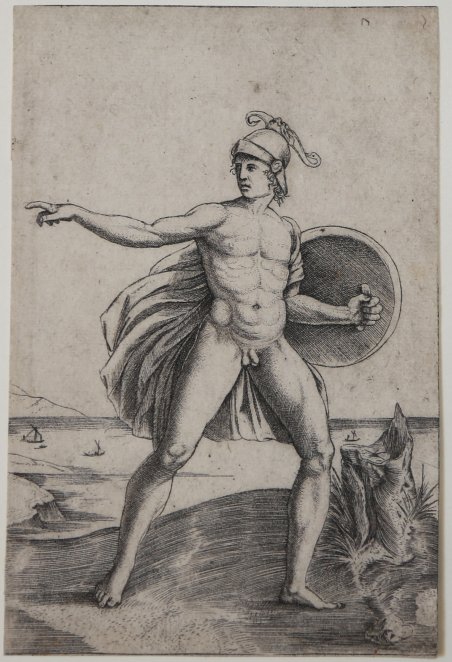
Un guerriero
Payment methods
- PayPal
- Credit card
- Bank transfer
- Pubblica amministrazione
- Carta del Docente
Details
- Year of publication
- 1520
- Size
- 104 X 158
- Engravers
- VENEZIANO Agostino de Musi detto
- Inscription description
- Bartsch XIV.343.461; Passavant 1864, VI, pp. 61-62, n. 106 (Musi ?); TIB, 27 p. 129, n. 461 (343)
Description
Bulino, 1515 – 1530. Primo stato di tre, ante litteram.Eccellente prova, impressa su carta vergata coeva, rifilata ai margini, in perfetto stato di conservazione.L’incisione mostra un guerriero nudo, con il braccio destro disteso mentre con la mano sinistra impugna uno scudo. Il paesaggio sullo sfondo ricalca, in controparte e con poche varianti, quello dello Sbandieratore di Dürer.Bartsch attribuisce l’opera ad Agostino Veneziano, probabilmente su progetto di Raffaello. Agostino de Musi, detto Agostino Veneziano, nacque in Veneto, forse a Venezia, intorno al 1490, periodo fissato approssimativamente dagli studiosi in base alle date più antiche incise su alcune stampe. Si recò a Roma nel 1515/16, dove entrò in rapporto con Marcantonio Raimondi, divenendone, insieme a Marco Dente, uno dei principali alfieri e poi collaboratori nella "ditta" Raimondi, la prima vera e propria impresa artistico-commerciale impegnata nella riproduzione di soggetti raffaelleschi. Ad un periodo, fino al 1520, di intensa attività della bottega di Marcantonio seguirono probabilmente anni più difficili dovuti alla morte di Raffaello nel 1520 e all'imprigionamento dello stesso Raimondi intorno al 1523-24 per aver inciso alcuni soggetti lascivi. ' Il sacco di Roma del 1527 spinse il De Musi a lasciare la città, verso Mantova, attratto da Giulio Romano. La produzione incisoria di Agostino è assai vasta e consistente numericamente, soprattutto se rapportata al breve arco di tempo in cui fu realizzata, all'incirca tra il 1514 e il 1536. Alle 139 incisioni riportate dal Bartsch sono da aggiungere le nuove 4 citate dal Passavant e le 8 riportate dallo Heinecken: si tratta di bulini tutti firmati o contrassegnati dal monogramma, a volte costituito da lettere normali, a volte da caratteri gotici; a queste opere sono da aggiungere anche un gruppo di circa 60 bulini anonimi di probabile o dubbia attribuzione. Opera rarissima. Engraving, 1515-1530, unlettered. First state, of three, ante litteram, before Salamanca’ address. Excellent impression, printed on contemporary laid paper, trimmed at margins, in excellent condition.The print shows a nude warrior, with one arm outstretched while the other holds a shield Attributed by Bartsch to Agostino, possibly after a design by Raphael. The landscape in the background reflects, in reverse, that one of the The Standard Bearer by Dürer. Agostino de Musi, known as Agostino Veneziano, was born in the Veneto, possibly in Venice, around 1490, a period set approximately by scholars based on the earliest dates engraved on some prints. He went to Rome in 1515/16, where he entered into a relationship with Marcantonio Raimondi, becoming, along with Marco Dente, one of his principal pupil and later collaborators in the Raimondi “firm,” the first real artistic-commercial enterprise engaged in the reproduction of Raphaelesque subjects. A period, until 1520, of intense activity in Marcantonio's workshop was probably followed by more difficult years due to Raphael's death in 1520 and the imprisonment of Raimondi himself around 1523-24 for engraving some lascivious subjects. The Sack of Rome in 1527 prompted De Musi to leave the city, heading for Mantua, attracted by Giulio Romano. The collaboration with Giulio coincided with a period characterized by high artistic achievements and intense production, dating from the years 1530-1532. ' Agostino's engraving production is very large and numerically consistent, especially when compared to the short time span in which it was produced, roughly between 1514 and 1536. To the 139 engravings reported by Bartsch must be added the new 4 cited by Passavant and the 8 reported by Heinecken: these are all signed or monogrammed engravingss, sometimes consisting of normal letters, sometimes of Gothic characters; to these works must also be added a group of about 60 anonymous enrgavings of probable or doubtful attribution. Very rare. Cfr. Bartsch XIV.343.461; Passavant 1864, VI, pp. 61-62, n. 106 (Musi ?); TIB, 27 p. 129, n. 461 (343)
