Veteris aquae Claudiæ ex Tiburtino forma
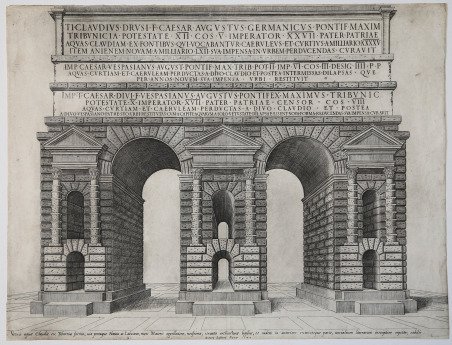
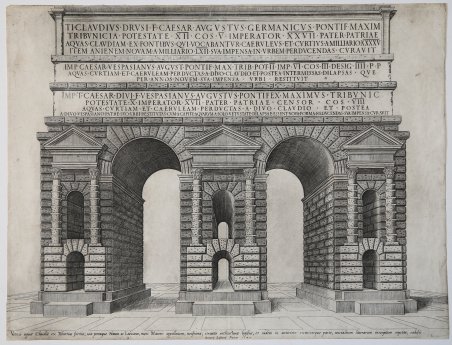
Veteris aquae Claudiæ ex Tiburtino forma
Payment methods
- PayPal
- Credit card
- Bank transfer
- Pubblica amministrazione
- Carta del Docente
Details
- Year of publication
- 1549
- Size
- 480 X 365
- Engravers
- LAFRERI Antonio
Description
Acquaforte e bulino, 1549, firmata e datata in lastra in basso al centro. ' Esemplare nel primo stato di quattro (cfr. Alberti, n. 51) o primo stato di tre (cfr. Rubach, n. 281), avanti l'indirizzo di Giovanni Orlandi. Iscritto in basso al centro: « Veteris aquae Claudiæ ex Tiburtino forma; uia portaque Noeuia ac Labicana, nunc Maioris appellatione, notissima; seruatis architecturæ legibus, et eadem in anteriore exterioreque parte, uncialium litterarum inscriptione repetita, nobilis » [Aspetto dell’antico acquedotto Claudio [proveniente] da Tivoli; la famosa via e porta Nevia e Labicana, ora chiamata «[Porta] Maggiore»; tenuto conto delle leggi dell’architettura, sia per la facciata anteriore che per quella posteriore, e con la trascrizione in lettere unciali della scritta; bellissima]. Il monumento è a doppio arco. La sua funzione era quella di consentire all’Acquedotto Claudio di scavalcare le vie Labicana e Prenestina. Secondo Spagnesi, le rappresentazioni cinquecentesche degli archi del Lafréry e del Serlio si differenziavano per il fatto che «il primo utilizzava prospettive con punto di fuga centrale per le ortogonali al piano di proiezione, prive di elementi diretti di misura del soggetto: una costante per tutto il Quattrocento da Brunelleschi a Giuliano da Sangallo. Non è un caso, se proprio da un disegno di quest’ultimo - addirittura - sembra in qualche modo derivata la stessa veduta lafreriana della Porta Maggiore. Il secondo, invece, impegnava proiezioni ortogonali con precise scale metriche, e relegava la prospettiva negli spigoli delle cornici e negli interni dei fornici per suggerire profondità, accennare spazi, non per rendere un oggetto nelle tre dimensioni». L’edizione del Lafréry è ripresa da quella edita per i tipi di Antonio Salamanca nel 1538. L’opera appartiene allo ' Speculum Romanae Magnificentiae, la prima iconografia della Roma antica. ' Lo ' Speculum ' ebbe origine nelle attività editoriali di Antonio Salamanca e Antonio Lafreri (Lafrery). Durante la loro carriera editoriale romana, i due editori - che hanno lavorato insieme tra il 1553 e il 1563 - hanno avviato la produzione di stampe di architettura, statuaria e vedutistica della città legate alla Roma antica e moderna. Le stampe potevano essere acquistate individualmente da turisti e collezionisti, ma venivano anche acquistate in gruppi più grandi che erano spesso legati insieme in un album. Nel 1573, Lafreri commissionò a questo scopo un frontespizio, dove compare per la prima volta il titolo Speculum Romanae Magnificentiae. Alla morte di Lafreri, due terzi delle lastre di rame esistenti andarono alla famiglia Duchetti (Claudio e Stefano), mentre un altro terzo fu distribuito tra diversi editori. Claudio Duchetti continuò l’attività editoriale, implementando le lastre dello Speculum con copie di quelle “perdute” nella divisione ereditaria, che fece incidere al milanese Amborgio Brambilla. Alla morte di Claudio (1585) le lastre furono cedute – dopo un breve periodo di pubblicazione degli eredi, in particolare nella figura di Giacomo Gherardi - a Giovanni Orlandi, che nel 1614 vendette la sua tipografia al fiammingo Hendrick van Schoel. Stefano Duchetti, al contrario, cedette le proprie matrici all’editore Paolo Graziani, che si associò con Pietro de Nobili; il fondo confluì nella tipografia De Rossi passando per le mani di editori come Marcello Clodio, Claudio Arbotti e Giovan Battista de Cavalleris. Il restante terzo di matrici della divisione Lafreri fu suddiviso e scisso tra diversi editori, in parte anche francesi: curioso vedere come alcune tavole vengano ristampate a Parigi da Francois Jollain alla metà del XVII secolo. Diverso percorso ebbero alcune lastre stampate da Antonio Salamanca nel suo primo periodo; attraverso il figlio Francesco, confluirono nella tipografia romana di Nicolas van Aelst. Altri editori che contribuirono allo Speculum furono i fratelli Michele e Francesco Tramezzino (auto. Etching and engraving, 1549, signed and dated on plate at the bottom center. ' Example of the first state of four (cf. Alberti, n. 51) or first state of three (cf. Rubach, n. 281), before the address of Giovanni Orlandi. Inscribed at the bottom center: "Veteris aquae Claudiæ ex Tiburtino forma; uia portaque Noeuia ac Labicana, nunc Maioris appellatione, notissima; seruatis architecturæ legibus, et eadem in anteriore exterioreque parte, uncialium litterarum inscriptione repetita, nobilis”. The monument has a double arch. Its function was to allow the Claudio Aqueduct to cross the Labicana and Prenestina streets. According to Spagnesi, the sixteenth-century representations of the Lafréry and Serlio arches differed in the fact that "the former used perspectives with a central vanishing point for the orthogonal ones at the projection plane, without direct elements of measurement of the subject: a constant throughout the fifteenth century from Brunelleschi to Giuliano da Sangallo. It is no coincidence that the same Lafrerian view of the Porta Maggiore seems in some way derived from the latter's drawing. The second, on the other hand, engaged orthogonal projections with precise metric scales, and relegated the perspective to the corners of the frames and the interiors of the arches to suggest depth, to hint at spaces, not to render an object in three dimensions". The Lafréry edition is taken from the one published by Antonio Salamanca in 1538 (cf. Marigliani III.9). The work belongs to the Speculum Romanae Magnificentiae, the earliest iconography of ancient Rome. ' The Speculum originated in the publishing activities of Antonio Salamanca and Antonio Lafreri (Lafrery). During their Roman publishing careers, the two editors-who worked together between 1553 and 1563-started the production of prints of architecture, statuary, and city views related to ancient and modern Rome. The prints could be purchased individually by tourists and collectors, but they were also purchased in larger groups that were often bound together in an album. In 1573, Lafreri commissioned a frontispiece for this purpose, where the title Speculum Romanae Magnificentiae appears for the first time. Upon Lafreri's death, two-thirds of the existing copperplates went to the Duchetti family (Claudio and Stefano), while another third was distributed among several publishers. Claudio Duchetti continued the publishing activity, implementing the Speculum plates with copies of those "lost" in the hereditary division, which he had engraved by the Milanese Amborgio Brambilla. Upon Claudio's death (1585) the plates were sold - after a brief period of publication by the heirs, particularly in the figure of Giacomo Gherardi - to Giovanni Orlandi, who in 1614 sold his printing house to the Flemish publisher Hendrick van Schoel. Stefano Duchetti, on the other hand, sold his own plates to the publisher Paolo Graziani, who partnered with Pietro de Nobili; the stock flowed into the De Rossi typography passing through the hands of publishers such as Marcello Clodio, Claudio Arbotti and Giovan Battista de Cavalleris. The remaining third of plates in the Lafreri division was divided and split among different publishers, some of them French: curious to see how some plates were reprinted in Paris by Francois Jollain in the mid-17th century. Different way had some plates printed by Antonio Salamanca in his early period; through his son Francesco, they goes to Nicolas van Aelst's. Other editors who contributed to the Speculum were the brothers Michele and Francesco Tramezzino (authors of numerous plates that flowed in part to the Lafreri printing house), Tommaso Barlacchi, and Mario Cartaro, who was the executor of Lafreri's will, and printed some derivative plates. All the best engravers of the time - such as Nicola Beatrizet (Beatricetto), Enea Vico, Etienne Duperac, Ambrogio Brambilla, and others ' - were called to Rome and employed for the intaglio of the works. All these p. Cfr.
